
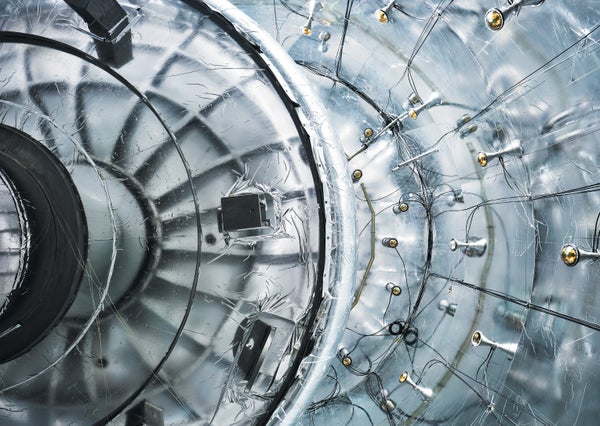
Sheltered underneath nearly a mile of rock in Abruzzo, Italy, scientists are hard at work unraveling the secrets of the universe's smallest bits of matter. When a radioactive process called beta decay occurs, it typically emits two particles: a negatively charged electron and a version of a tiny, neutrally charged neutrino. The Large Enriched Germanium Experiment for Neutrinoless Double Beta Decay (LEGEND-200) at the Gran Sasso National Laboratory is designed to figure out whether this process can occur without resulting in a neutrino at the end. The answer could shape our understanding of how matter came to be.
The process of “neutrinoless double beta decay,” if it does occur, happens very rarely. Noticing when decay results in electrons but not neutrinos can be difficult, especially because neutrinos are plentiful everywhere—billions pass through your body every second—and are often produced when background radiation reacts with machine components.
That's why scientists focus on “choosing really low-radioactivity materials to start with and then also coming up with lots of clever ways to reject background [particles],” says Drexel University particle physicist Michelle Dolinski, who is not involved in the project.
On supporting science journalism
If you're enjoying this article, consider supporting our award-winning journalism by subscribing. By purchasing a subscription you are helping to ensure the future of impactful stories about the discoveries and ideas shaping our world today.
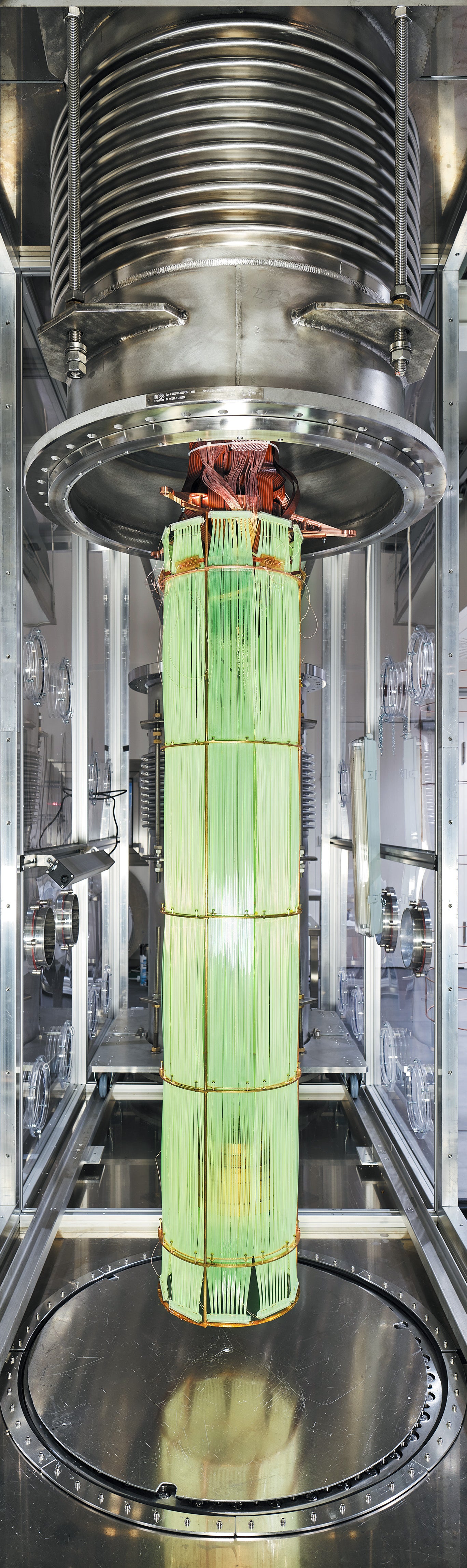
Credit: Enrico Sacchetti
LEGEND-200 is equipped with slightly radioactive germanium crystals, which act as both a source of beta decay and a neutrino detector. To screen out ambient particles, the entire setup is immersed in a cryogenic tank shielded by water and liquid argon. That core is surrounded with green optical fibers and a reflective film that bounces away stray particles.
If LEGEND-200 observes neutrinoless double beta decay, it will mean that unlike protons, electrons and other elementary particles—which each have an “antiparticle” that destroys them on contact—neutrinos are their own antiparticles and can destroy one another. If this is the case, then when double beta decay occurs, two neutrinos would be produced and immediately annihilated, leaving none behind. “This is an important ingredient in trying to understand why matter dominated over antimatter in the early universe and why the universe exists as it does today,” Dolinski says.
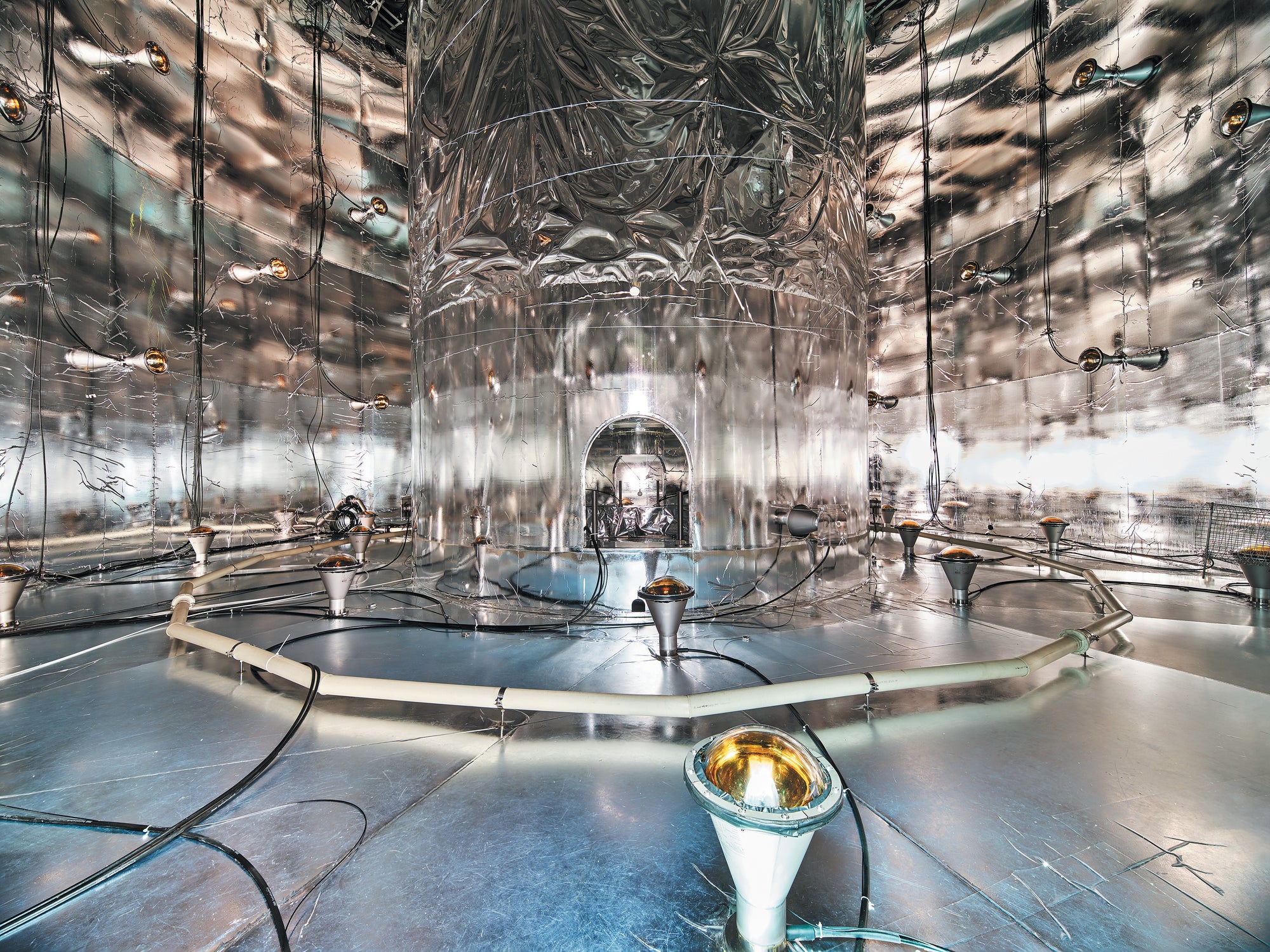
Inside the water tank, mirror film surrounds the liquid-argon cryostat. Credit: Enrico Sacchetti
LEGEND collaborator Laura Baudis, who is an experimental physicist at the University of Zurich, is excited to see what this experiment uncovers when it begins collecting data later this year. “There are so many things we don't know about neutrinos,” she says. “They're really still full of surprises.”