
The following essay is reprinted with permission from  The Conversation, an online publication covering the latest research.
Sourdough is the oldest kind of leavened bread in recorded history, and people have been eating it for thousands of years. The components of creating a sourdough starter are very simple – flour and water. Mixing them produces a live culture where yeast and bacteria ferment the sugars in flour, making byproducts that give sourdough its characteristic taste and smell. They are also what make it rise in the absence of other leavening agents.
My sourdough starter, affectionately deemed the “Fosters” starter, was passed down to me by my grandparents, who received it from my grandmother’s college roommate. It has followed me throughout my academic career across the country, from undergrad in New Mexico to graduate school in Pennsylvania to postdoctoral work in Washington.
On supporting science journalism
If you're enjoying this article, consider supporting our award-winning journalism by subscribing. By purchasing a subscription you are helping to ensure the future of impactful stories about the discoveries and ideas shaping our world today.
Currently, it resides in the Midwest, where I work at The Ohio State University as a senior research associate, collaborating with researchers to characterize samples in a wide variety of fields ranging from food science to material science.
As part of one of the microscopy courses I instruct at the university, I decided to take a closer look at the microbial community in my family’s sourdough starter with the microscope I use in my day-to-day research.
Scanning electron microscopes
Scanning electron microscopy, or SEM, is a powerful tool that can image the surface of samples at the nanometer scale. For comparison, a human hair is between 10 to 150 micrometers, and SEM can observe features that are 10,000 times smaller.
Since SEM uses electrons instead of light for imaging, there are limitations to what can be imaged in the microscope. Samples must be electrically conductive and able to withstand the very low pressures in a vacuum. Low-pressure environments are generally unfavorable for microbes, since these conditions will cause the water in cells to evaporate, deforming their structure.
To prepare samples for SEM analysis, researchers use a method called critical point drying that carefully dries the sample to reduce unwanted artifacts and preserve fine details. The sample is then coated with a thin layer of iridium metal to make it conductive.
Exploring a sourdough starter
Since sourdough starters are created from wild yeast and bacteria in the flour, it creates a favorable environment for many types of microbes to flourish. There can be more than 20 different species of yeast and 50 different species of bacteria in a sourdough starter. The most robust become the dominant species.
You can visually observe the microbial complexity of sourdough starter by imaging the different components that vary in size and morphology, including yeast and bacteria. However, a full understanding of all the diversity present in the starter would require a complete gene sequencing.
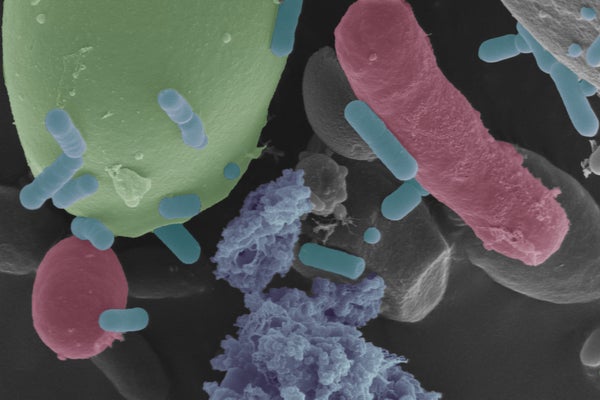
The main component that gives the starter texture are starch grains from the flour. These grains, colored green in the image, are identifiable as relatively large globular structures approximately 8 micrometers in diameter.
Giving rise to the starter is the yeast, colored red. As the yeast grows, it ferments sugars from the starch grains and releases carbon dioxide bubbles and alcohol as byproducts that make the dough rise. Yeast generally falls in the range of 2 to 10 micrometers in size and are round to elongated in shape. There are two distinct yeast types visible in this image, one that is nearly round, at the bottom left, and another that is elongated, at the top right.
Bacteria, colored blue, metabolize sugars and release byproducts such as lactic acid and acetic acid. These byproducts act as a preservative and are what give the starter its distinctive sour smell and taste. In this image, bacteria have pill-like shapes that are approximately 2 micrometers in size.
Now, the next time you eat sourdough bread or sourdough waffles – try them, they’re delicious! – you can visualize the rich array of microorganisms that give each piece its distinctive flavor.
This article was originally published on The Conversation. Read the original article.