
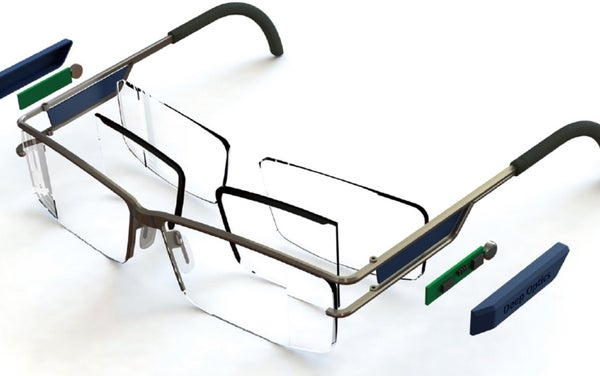
As people age, they often require bifocals or several pairs of glasses to see objects both near and far. Deep Optics, a technology start-up based in Israel, is working on an alternative: eyeglasses that automatically refocus on any target at which the wearer looks. The “omnifocals” adjust focal length by relying on the interaction between an electric current and liquid crystal, a material in which molecules act like both liquids and solids.
Although some smartphone camera lenses already include this technology, the effect has yet to be achieved in larger lenses. So far Deep Optics has built a small 20-by-20-millimeter working lens and a distance-detection system—two components that, once integrated, can essentially change the prescription of the glasses in an instant depending on where the person directs his or her gaze. The company plans to have a full-size prototype ready for testing and demonstration in about two years. CEO Yariv Haddad says this technology may also find a place in augmented- and virtual-reality devices, which currently display objects from a single distance and can therefore cause disorienting blurriness.
How It Works
On supporting science journalism
If you're enjoying this article, consider supporting our award-winning journalism by subscribing. By purchasing a subscription you are helping to ensure the future of impactful stories about the discoveries and ideas shaping our world today.
The wearer trains his or her eyes on an object. Infrared sensors on the frames measure the distance between the pupils and send this information to an embedded processing unit that calculates the distance to the object.
Based on the distance calculation, a built-in rechargeable battery sends a particular electric current through the lenses, which comprise three layers. A microns-thick layer of liquid crystal sits between two layers of glass coated with indium tin oxide, a transparent conducting material.
As the voltage of the liquid-crystal layer changes, the orientation and distribution of the crystals shift, altering the path that light takes through the lenses. As a result, the refractive index changes. (In conventional eyeglasses, variations in the thickness of the lenses achieve the same effect.) It takes 100 to 300 milliseconds for this adjustment to occur—comparable to the roughly 300 milliseconds it takes the human eye to focus.