
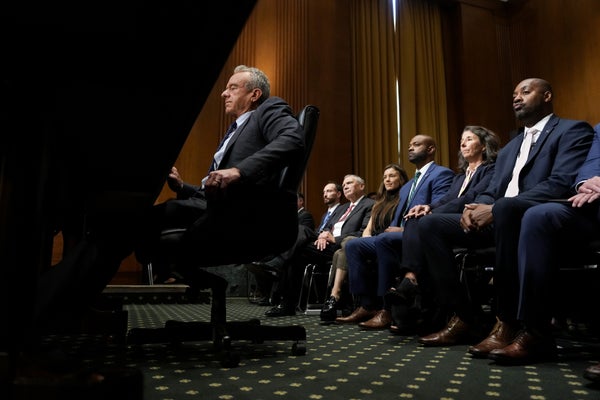
On Thursday a combative and acerbic Robert F. Kennedy, Jr., secretary of the U.S. Department of Health and Human Services, appeared before the Senate Committee on Finance and fielded angry questions from some of the very senators that helped him join President Donald Trump’s cabinet. The senators’ concerns included the firing of the Centers for Disease Control and Prevention’s newly appointed director Susan Monarez and Kennedy’s decisions to limit vaccine development and availability.
Kennedy often interrupted the questioning: He told Senator Bill Cassidy of Louisiana, “You’re wrong,” when Cassidy said Kennedy was denying people COVID vaccines. And Kennedy told Senator Maggie Hassan of New Hampshire, “You’re just making stuff up,” after she questioned what evidence he and the Food and Drug Administration used to change COVID vaccine recommendations. Kennedy defended his decision to fire Monarez after only 29 days of service by claiming that she said “no” when asked if she was “trustworthy.” In a piece in the Wall Street Journal, Monarez wrote that Kennedy had asked her to sign off on “the recommendations of a vaccine advisory panel newly filled with people who have publicly expressed antivaccine rhetoric.”
The hearing had originally been scheduled for Kennedy to talk about the president’s health agenda, but in light of a gunman firing on the CDC last month, the FDA’s decision on COVID vaccines and Monarez’s ouster, several senators used it to excoriate Kennedy for weakening the American public health system. Many public officials and health-related organizations have called for Kennedy’s resignation.
On supporting science journalism
If you're enjoying this article, consider supporting our award-winning journalism by subscribing. By purchasing a subscription you are helping to ensure the future of impactful stories about the discoveries and ideas shaping our world today.
Throughout the hearing, public health experts, medical professionals and scientists responded on social media. A selection of such comments is below.
“Dr. Monarez was told days before she was fired that she could not decide vaccine policy. We spoke on the phone and she said ‘I won’t ever abandon you, but I am no longer able to be involved in vaccine policy per HHS. Those decisions need to go through the chief of staff.’” —Demetre C. Daskalakis, former director, National Center on Immunization and Respiratory Diseases, CDC, writing on X
“Thom Tillis (R) really lays into RFK [Jr.]. Goes after him on everything from vaccines to the Big Beautiful Bill, gently pointing out that he's effectively, and repeatedly, lied. Wants a ‘written statement’ from RFK [Jr.] on his view of Warp Speed and RNA tech. RFK [Jr.] not getting overwhelming support from GOP.” —Pam Herd, Social Sciences University of Michigan, writing on Bluesky
“Kennedy continues to claim that vaccines aren’t adequately tested.
“He is a liar. They are the most thoroughly tested intervention of all.” —Elizabeth Jacobs, epidemiologist, Defend Public Health, and professor emerita, University of Arizona, writing on Bluesky
“Stop thinking [Kennedy] will be truthful. He won’t. He is a threat to public health & scientific progress. He’s demonized innovation for:
“Food safety
“Food stability
“Farming
“Infectious diseases
“Cancer
“Genetic disorders
“Dental health
“Public & population health
“The environment.” —Andrea Love, scientist, writing on Bluesky
“Unbelievable
“‘We are the sickest country in the world. That’s why we have to fire people at the CDC. They did not do their job’ - RFK Jr
“CDC folks have been fired, fired at, and now being blamed for the country’s health crisis by a anti-science quack.” —Madhu Pai, public health and tuberculosis expert, McGill University, writing on Bluesky
“Confirming a man who is arguably the world’s most extreme & dangerous anti-vaxx activist & conspiracy theorist was a massive failure…..” —Gavin Yamey, global health expert, Duke University, writing on Bluesky
“It’s very clear that RFK Jr. has been lying throughout his entire senate hearing that happened earlier today.” —Zachary Rubin, physician and science communicator, speaking on Instagram
“[Kennedy said], ‘We are the sickest country in the world. That’s why we have to fire people at the CDC!’
“Wrong. We are not the ‘sickest country in the world.’ Not even close, by any measure.
“He fired people at CDC because they would not agree to carry out his plan to end vaccines in America.” —Angela Rasmussen, infectious disease expert, University of Saskatchewan, writing on X