
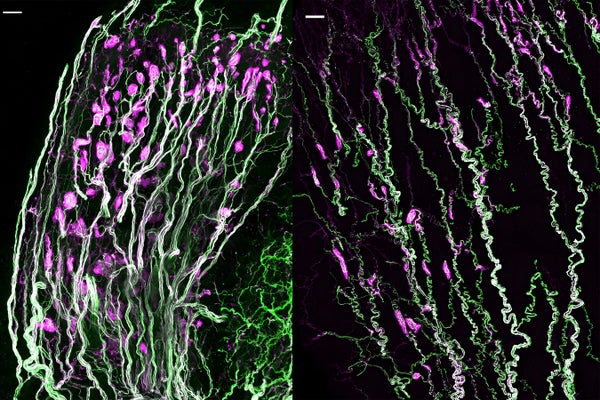
Specific nerve cells on the penis and clitoris detect vibrations and then become activated, causing sexual behaviours such as erections, a study in mice has revealed. The findings could lead to new treatments for conditions such as erectile dysfunction, or for restoring sexual function in people with lower-body paralysis.
Krause corpuscles — nerve endings in tightly wrapped balls located just under the skin — were first discovered in human genitals more than 150 years ago. The structures are similar to touch-activated corpuscles found on people’s fingers and hands, which respond to vibrations as the skin moves across a textured surface.
But there is little research into how the genital corpuscles work and how they are involved in sex, probably because the topic is sometimes considered taboo. “It’s been hard to get people to work on this because some people have a hard time talking about it,” says David Ginty, a sensory neurobiologist at Harvard Medical School in Boston, Massachusetts, who led the team that conducted the latest research. “But I don’t, because the biology is so interesting.”
On supporting science journalism
If you're enjoying this article, consider supporting our award-winning journalism by subscribing. By purchasing a subscription you are helping to ensure the future of impactful stories about the discoveries and ideas shaping our world today.
Good vibrations
Ginty and other sensory biologists have long wanted to study these mysterious neuron balls. But activating and tracking specific neurons was nearly impossible until advanced molecular techniques emerged in the past 20 years.
In a 19 June paper in Nature, Ginty and his collaborators activated the Krause corpuscles in both male and female mice using various mechanical and electrical stimuli. The neurons fired in response to low-frequency vibrations in the range of 40–80 hertz. Ginty notes that these frequencies are generally used in many sex toys; humans, it seems, realized that this was the best way to stimulate Krause corpuscles before any official experiments were published.
The researchers, who last year made the research public on the preprint server bioRxiv ahead of peer review, also found that the genitalia of male and female mice contain about the same number of corpuscles, which spread out spatially as the organs grow during the animals’ development. But the corpuscles are 15 times as concentrated on the clitoris as on the penis, because the clitoris is smaller. “It’s almost wall-to-wall Krause corpuscles” on the clitoris, Ginty says, “and we think each is a vibration detector” — which could help to explain why the organ is so sensitive.
To learn what part the corpuscles play in sex, the team genetically engineered mice so that the corpuscle neurons would fire when exposed to a flash of light. In anaesthetized mice, this activation caused erections in males and vaginal contractions in females. Mice that were genetically engineered to lack Krause corpuscles couldn’t mate normally, suggesting that the structures are necessary for sex.
Although most sensory neurons are developed before birth, the researchers found that Krause corpuscles didn’t develop until the mice were around 4–6 weeks old — just before the animals reached sexual maturity. Ginty says the team is studying whether hormones in the female mouse’s oestrus cycle affect the corpuscles’ function, as well as how these late-developing neural systems wire themselves into the body’s existing nervous system.
So far, the researchers have learnt that the corpuscles connect to a particular sensory region of the spinal cord. Stimulating this region caused erections and contractions in the genitals, even if the spinal cord’s connection to the brain had been severed, suggesting that sexual reflexes are automatic.
Sexual healing
“It’s a very comprehensive piece of work,” says Elena Gracheva, a neuroscientist at Yale University in New Haven, Connecticut. She was struck by how many sensory pathways seem to be involved in genital sensitivity. The paper “opens a lot of different directions for a lot of scientists”, she says.
Alexander Chesler, a sensory biologist at the National Center for Complementary and Integrative Health in Bethesda, Maryland, says that the study complements a paper his group published last year showing that a touch-sensitive protein in the genitals is necessary for successful mating. “Sex is a fundamental area of biology and is one of the main drivers of behaviour and evolution,” Chesler says. He hopes that further research into these nerve cells will eventually lead to treatments for conditions such as erectile dysfunction and vaginal pain.
Ginty and his coworkers now want to look at other aspects of Krause corpuscles, such as whether the neurons cause pleasure sensations in the brain and whether they retain their sensitivity as animals age. “Every finding leads to some new insight because there’s so much we don’t know about this,” Ginty adds.
This article is reproduced with permission and was first published on June 19, 2024.