
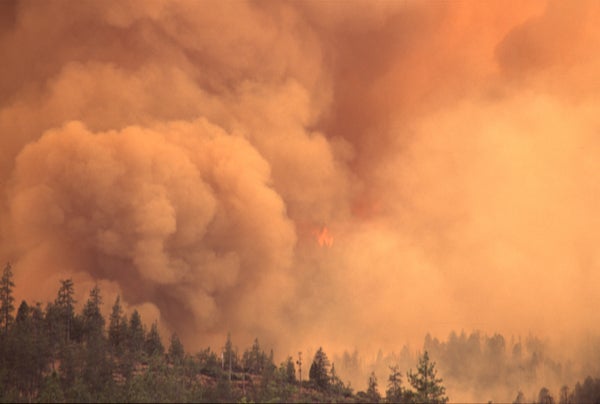
Proponents of more-aggressive forest management practices are citing wildfires currently burning in the western United States and linking them to climate change.
Western wildfire experts, brought together by the climate communications firm Climate Nexus, called yesterday for more intentional burning of forests, as well as mechanical tree removal, to make them less susceptible to extreme wildfires.
They said treating the forests can help combat increased fire risk caused by climate change, as well as the buildup of fuel caused by previous attempts to suppress fires entirely.
On supporting science journalism
If you're enjoying this article, consider supporting our award-winning journalism by subscribing. By purchasing a subscription you are helping to ensure the future of impactful stories about the discoveries and ideas shaping our world today.
“We are in an enviable position here where we’re influenced both by climate change and the consequences of a century of more of fire suppression and land-use choices that reduced fire on the landscape,” said LeRoy Westerling, a professor at the University of California, Merced.
Westerling published a study last month finding that wildfire activity in the western United States has increased significantly over the past 30 years and is associated with warming temperatures and earlier spring snowmelt.
“Fortunate in the sense that there’s something we can do to make our forests more resilient here,” he said. “We can treat fuels and make the forests much more robust to climate change and reduce the fire risk.”
A top California forestry official pointed to a string of severe fires in recent years that have raised awareness of the need to deal with fire risks.
“This frequency of these events of 50,000- to 100,000-plus acres means that the public perception of risk is changing, and their willingness and the willingness of the state’s political apparatus to engage with fire issues has probably never been higher within my career in forestry,” said Keith Gilless, the chairman of California’s Board of Forestry and Fire Protection and dean of the University of California, Berkeley’s College of Natural Resources.
He put the Erskine Fire, currently burning in Kern County, in the same context as other major fires, including the Rim Fire, the King Fire, the Valley Fire and the Butte Fire. The Erskine Fire, currently at 46,000 acres, has killed two people and destroyed more than 200 structures. “We’re already off to the races with the Erskine Fire this year,” Gilless said.
Gilless said the forestry and fire board is working on an overarching fuels treatment plan that would allow it to approve projects on 22 million acres of private lands across the state.
He said climate change is increasing the need for firefighting resources. “I don’t envision the fire season ever really shutting down, if we look over Southern California,” he said. “Staffing and resources for deployment is going to be a permanent feature rather than a seasonal feature.”
A watchdog group, on the other hand, said the advocates are conflating forest fires with the current headline-grabbing wildfires in an attempt to drum up support for forest treatments. The Erskine Fire could not have been prevented or dampened by fuel treatment, because it is on land covered by brush and short grass, they said. Another 46,000-acre fire cited by Climate Nexus, the Cedar Fire in eastern Arizona, is also on brushlands, and the 7,500-acre Sherpa Fire, on the edge of the Los Padres National Forest in Southern California, is on chaparral, tall grass and brush—not forests.
“The Erskine Fire is a lousy place for prescribed burning,” said Andy Stahl, executive director of Forest Service Employees for Environmental Ethics, a nonprofit that often provides a counternarrative to federal arguments for more fire-suppression and firefighting dollars. “They’re just using the fact it’s in the headlines because so many homes were lost.”
Stahl said homeowners should focus on eliminating flammable materials around their homes, like debris, firewood and propane, rather than prescribed burning.
“Prescribed burning is fine; it’s a fine thing to do. We don’t do nearly enough of it,” he said. “What people shouldn’t get the idea of is that any amount of prescribed burning or thinning or any of those other things will protect their homes. Just don’t make that connection, because there is no linkage.”
Reprinted from Climatewire with permission from Environment & Energy Publishing, LLC. www.eenews.net, 202-628-6500