
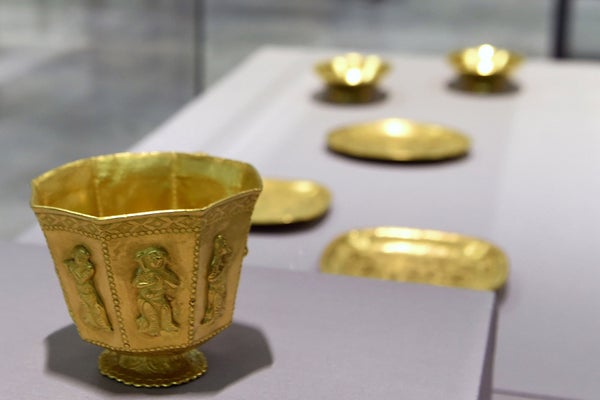
A museum show of sumptuous treasures from a ninth-century shipwreck is being denounced by researchers, who say that commercial salvage of the artefacts irreversibly damaged the wreck’s scientific value.
On 6 February, the Advisory Council on Underwater Archaeology sent a letter of opposition to the Asia Society, the non-profit group that is mounting the show of Chinese Tang-dynasty porcelains, gold vessels and other objects from the wreck at its New York City museum. Critics fear that the exhibition, slated to open on March 7, will encourage exploitation of wrecks by for-profit firms.
Museums that show salvaged treasures don’t intend to promote treasure-hunting, “but that’s the effect it has”, says Marco Meniketti, an archaeologist at San José State University in California who leads the advisory council.
On supporting science journalism
If you're enjoying this article, consider supporting our award-winning journalism by subscribing. By purchasing a subscription you are helping to ensure the future of impactful stories about the discoveries and ideas shaping our world today.
Artefacts from the Belitung wreck, named after the Indonesian island close to the ship’s final resting spot, were scheduled to go on display at the Smithsonian Institution's Sackler Gallery in Washington DC in 2012. The institution cancelled the exhibition in December 2011 after vocal opposition from Smithsonian scientists and others.
But the problems presented by exhibiting the spoils of commercial salvage remain, says maritime archaeologist Filipe Castro at Texas A&M University in College Station. That type of excavation “silences all the questions that a vessel like that could answer”, he says, reeling off a list of data that should have been collected at the Belitung site.
In a statement, the Asia Society said that “American audiences should have an opportunity to see this material because of its significance”. In recognition of “the sensitivities” around the exhibition, the society is co-sponsoring a public symposium about the ethics of archaeology and commercial salvage.
And the head of Seabed Explorations, the company that salvaged the wreck, defended his team’s work. “Without Seabed Explorations there wouldn’t be any data existing at all about the Belitung shipwreck,” says Tilman Walterfang.
Rocky shoals
With 17,000 islands and a location central to maritime trade, Indonesia is rich in shipwrecks. But it is less endowed with resources to protect and study them. After fishermen found the Belitung wreck nearly 20 years ago, looters began to circle the site. Seabed Explorations of Nelson, New Zealand, received a contract to excavate the wreck.
Company staff discovered a spectacular hoard on a Middle Eastern ship bound for an empire that included present-day Iran and Iraq. The wreck confirms that sea-based commerce between China and West Asia was thriving more than a millennium ago.
Workers recovered some 60,000 artefacts during field seasons in 1998 and 1999. In 2005, a subsidiary corporation set up by the government of Singapore purchased the cargo for US $32 million. The artefacts now belong to Singapore’s Asian Civilisations Museum.
Archaeologists tracking the Belitung objects point to a 2001 convention of the United Nations Educational, Scientific and Cultural Organization (UNESCO), which states that “underwater cultural heritage shall not be traded, sold, bought or bartered as commercial goods”. Such commerce results in the destruction of archaeological sites, says Diane Gifford-Gonzalez, an archaeologist at the University of California, Santa Cruz, and president of the Society for American Archaeology, which opposes the New York show. (Indonesia, Singapore and the United States are not parties to the UNESCO convention, which calls for sanctions against violators.)
Researchers also say that when salvage companies control a site, they have an incentive to focus on eye-catching treasures instead of scientifically valuable items such as potsherds, which can be easily overlooked. The New York show is “creating a precedent for continued destruction of sites”, says maritime archaeologist Jeremy Green at the Western Australian Museum in Fremantle, near Perth.
Hasty haul
Officials from Seabed acknowledge that a good portion of the artefacts were salvaged without precise documentation, but they say that the Indonesian government’s demands and the threat of looting required them to do the first round of fieldwork in haste. Moreover, Walterfang says, political instability made it difficult to recruit archaeologists to work on the first round of excavation.
During the second round, however, the locations of objects were precisely recorded, says Michael Flecker, who oversaw the second field season for Seabed and is now a maritime archaeologist at the ISEAS Yusof Ishak Institute of Singapore. That fieldwork quickly led to a paper about the ship in a peer-reviewed journal1.
But removing so many objects from the wreck without full knowledge of their original positions means that much of the ship’s scientific potential will never be realized, says maritime archaeologist Elizabeth Greene of Brock University in St Catharines, Canada. “The project is described as one of the most important archaeological revelations of the twentieth century. It’s not,” she says. “It’s perhaps one of the most important sabotaged treasures of the twentieth century.”
When the Smithsonian cancelled its show in 2011, museum officials said that they would pursue further excavation of the Belitung site. But Flecker says that when he saw the wreck in 2013, “the entire hull had been ripped apart” by looters. Even if the Smithsonian had been given permission to excavate, “there would have been nothing left to record”.
This article is reproduced with permission and was first published on February 7, 2017.