
If signs of life exist on Jupiter’s icy moon Europa, they might not be as hard to find as scientists had thought, a new study reports.
The 1,900-mile-wide (3,100 kilometers) Europa harbors a huge ocean beneath its icy shell. What’s more, astronomers think this water is in contact with the moon’s rocky core, making a variety of complex and intriguing chemical reactions possible.
Researchers therefore regard Europa as one of the solar system’s best bets to harbor alien life. Europa is also a geologically active world, so samples of the buried ocean may routinely make it to the surface—via localized upwelling of the ocean itself, for example, and/or through geyser-like outgassing, evidence of which has been spotted multiple times by NASA’s Hubble Space Telescope. [Photos: Europa, Mysterious Icy Moon of Jupiter]
On supporting science journalism
If you're enjoying this article, consider supporting our award-winning journalism by subscribing. By purchasing a subscription you are helping to ensure the future of impactful stories about the discoveries and ideas shaping our world today.
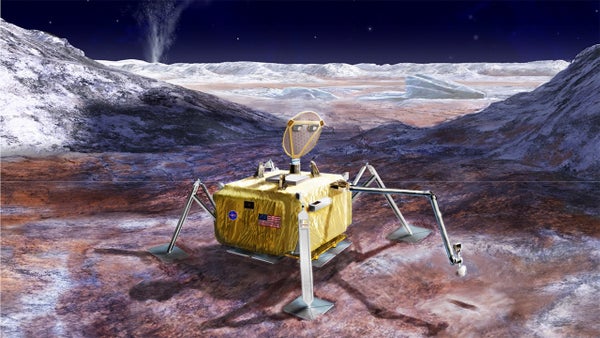
NASA aims to hunt for such samples in the not-too-distant future. The agency is developing a flyby mission called Europa Clipper, which is scheduled to launch in the early 2020s. Clipper will study Europa up close during dozens of flybys, some of which might be able to zoom through the moon’s suspected water-vapor plumes. And NASA is also working on a possible post-Clipper lander mission that would search for evidence of life at or near the Europan surface.
It’s unclear, however, just how deep a Europa lander would need to dig to have a chance of finding anything. That’s because Europa orbits within Jupiter’s radiation belts and is bombarded by fast-moving charged particles, which can turn amino acids and other possible biosignatures into mush.
That’s where the new study comes in.
NASA scientist Tom Nordheim and his colleagues modeled Europa’s radiation environment in detail, laying out just how bad things get from place to place. They then combined these results with data from laboratory experiments documenting how quickly various radiation doses carve up amino acids (a stand-in here for complex biomolecules in general).
The researchers found significant variation, with some Europan locales (equatorial regions) getting about 10 times the radiation pounding of others (middle and high latitudes).
At the most benign spots, the team determined, a lander would likely have to dig just 0.4 inches (1 centimeter) or so into the ice to find recognizable amino acids. In the high-blast zones, the target depth would be on the order of 4 to 8 inches (10 to 20 cm). (This is not to imply that potential Europan organisms would still be alive at such depths, however; doses there are high enough to cook even the hardiest Earth microbes, study team members said.)
That latter range is still quite manageable, said Nordheim, who’s based at the California Institute of Technology and NASA’s Jet Propulsion Laboratory, both of which are in Pasadena.
“Even in the harshest radiation zones on Europa, you really don’t have to do more than scratch beneath the surface to find material that isn’t heavily modified or damaged by radiation,” he told Space.com.
That’s good news for the potential lander mission, Nordheim added: With radiation exposure seemingly not a limiting factor, planners can feel free to target the areas of Europa most likely to harbor fresh ocean deposits—the fallout zone beneath a plume, for example—wherever they may lie.
Scientists still haven’t identified any such promising touchdown areas; the Europa imagery captured to date just hasn’t been sharp enough. But Europa Clipper’s work should change things, Nordheim said.
“When we get the Clipper reconnaissance, the high-resolution images—it’s just going to be a completely different picture,” he said. “That Clipper reconnaissance is really key.”
The new study was published online today (July 23) in the journal Nature Astronomy.
Copyright 2018 SPACE.com, a Purch company. All rights reserved. This material may not be published, broadcast, rewritten or redistributed.