
A long, long time ago I dropped an American history course after the professor answered a student's question with, “In some cases, people were as much a part of the problem as anyone else.” At the time, I doubted this guy had much to teach me. But recent events have made me reconsider his pedagogical prowess. I now believe people may indeed be as much a part of the problem as anyone else.
For example, it's been known for years that Volkswagen doctored its emissions tests to meet pollution standards. But only in late January did we learn about the monkeys. From the New York Times: “In 2014 ... scientists in an Albuquerque laboratory conducted an unusual experiment: Ten monkeys squatted in airtight chambers, watching cartoons for entertainment as they inhaled fumes from a diesel Volkswagen Beetle.”
Rest assured, no monkeys were harmed. By the cartoons. The fumes may have been harmful but less so than usual. Because the test of the Volkswagen was a dodge: the diesel Beetle in question had been modified to put out relatively clean exhaust.
On supporting science journalism
If you're enjoying this article, consider supporting our award-winning journalism by subscribing. By purchasing a subscription you are helping to ensure the future of impactful stories about the discoveries and ideas shaping our world today.
The chicanery outraged PETA, People for the Ethical Treatment of Animals, which issued a statement noting that lab monkeys are deprived of fresh air and sunshine. I love monkeys—they're some of my closest evolutionary relatives—but they weren't the only victims. The totality of the VW pollution-standards fakery resulted in years of additional pollution, which deprived all primates (including you, pal) of fresh air and sunshine. Anyway, I'm awarding a point to my history prof: the monkeys were unwitting pawns, and it was, in fact, people who were arguably the biggest part of the VW Bug problem.
Then we have Saudi Arabia's camel contest. Reports broke in late January that some entrants in the King Abdulaziz Camel Festival's beauty contest had been disqualified because they'd received Botox injections. The botulinum toxin helps to inflate facial features such as the lips and nose, thus allowing a given camel to live up to local standards of dromedary attractiveness.
Owners are no doubt driven by pride, although the millions of dollars in prize money may also be a motivating factor. (The idea of injecting Botox into a camel is laughable in the U.S., where the neurotoxin is used properly. That is, to transform human lips into a virtual bill and thus imbue the recipient with that much sought after duck face.) Another point for my prof: innocent ungulates are surely not to blame; once again, it is people who make up the lion's share of the camel problem.
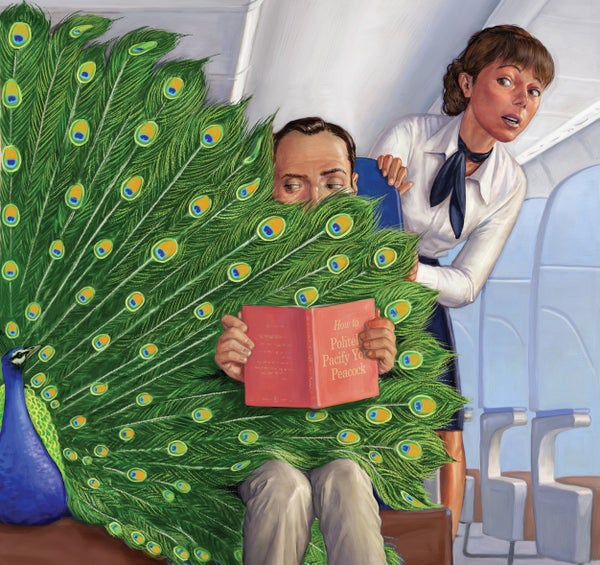
There's also the January case of the woman who was not allowed to board a plane with what press reports called “her emotional support peacock.” I'm less taken aback by her attempt to fly with a peacock than with the assertion that the humongous bird offers someone succor. Peacocks are allowed to roam free at the Bronx Zoo, and confronting one on a walking path always triggers my fight-or-flight response. Maybe seeing me activates the bird's fight-or-flight as well. It would have the advantage as far as flight. Just not commercial flight. Problem: people, not peacocks.
Finally, congratulations to Philadelphia. The city's most famous figure, Benjamin Franklin, is reputed to have said, “Games lubricate the body and the mind,” and there was much lubrication to be found following the Super Bowl win by the Philadelphia Eagles. Media outlets reported that before the game, Philly officials coated the lampposts lining downtown streets with hydraulic fluid. To keep ebullient Eagles enthusiasts (themselves possibly lubricated, if you know what I mean) from climbing the posts, as is local custom following athletic achievement.
Still, and despite their low coefficient of friction, the posts became festooned with fans, all of whom would be classified by taxonomists as people. Who, as is now established, are as much a part of the problem as anyone else. Because, as Franklin also purportedly said, “Wise men don't need advice. Fools won't take it.”