
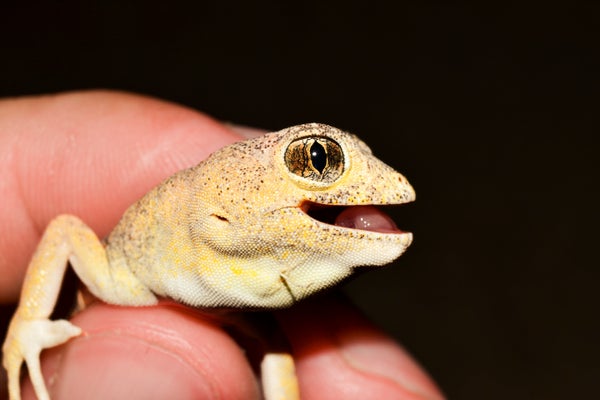
On a cool, starry night six years ago, a young scientist crept barefoot across dunes in the Namib Desert in southern Africa. With his pants slung over one arm and his flashlight sweeping the sand, the researcher, François Becker, was hunting—not for the black rhinos, elephants, ostriches or hyenas that make their homes there but for an elusive creature called the barking gecko. These ultra-shy lizards are only about the size of a stick of string cheese, but they possess powerful vocal cords to sing their nightly love songs. These tunes would eventually lead Becker to a startling discovery about the species that make them.
Males issue the calls, which sound like a cartoon villain’s evil laugh, from the entrance of their burrows to attract mates (and sometimes frighten tourists, who can be surprised that such small creatures can make such a loud noise). But because the animals’ calls vary slightly in pitch and frequency, they also intrigued Becker, who was doing research at Gobabeb Namib Research Institute. He was curious to find out why the mating calls sounded so different in two nearby areas that were thought to be home to a single species, Ptenopus garrulus.

Ptenopus maculatus (top) and Ptenopus garrulus (bottom).
François Becker
On supporting science journalism
If you're enjoying this article, consider supporting our award-winning journalism by subscribing. By purchasing a subscription you are helping to ensure the future of impactful stories about the discoveries and ideas shaping our world today.
Becker had previously worked with frogs and knew that different species have unique mating calls to prevent interbreeding. “So when I heard those call differences, I was immediately like, ‘Okay, there’s something happening here,’” he says.
During that night on the dunes, and others like it since then, Becker would sneak up on the geckos—lizards in the suborder Gekkota, which includes the only lizards with true vocal cords—partially clothed so that the swish of his pants wouldn’t scare them away. He collected specimens from the Namib Sand Sea in western-central Namibia, where he heard one type of call, and from the nearby gravel plains found on the opposite side of the Kuiseb River, where he heard another.
He sent DNA samples from the geckos out for genetic sequencing. When they didn’t match, he realized they were from distinct species (Ptenopus maculatus and Ptenopus circumsyrticus). He spent several years scooping up even more geckos from other areas of varied terrain in the Namib and Kalahari deserts, working under the hypothesis that separate species might prefer different soils for their burrows.
A male gecko (P. maculatus) calls from the entrance of his burrow.
This month Becker—now the chief curator of natural science at the National Museum of Namibia—published a paper in Vertebrate Zoology that revealed that the three species of barking geckos known to inhabit southern Africa are actually nine species. “Some of these species that were previously put together as one species are actually separated by 25 million years of evolution,” Becker says.
But it’s little wonder that these lizards hid under the same species name for so long. Barking geckos leave their burrows so rarely that even farmers who have heard the creatures on their land for decades likely have never seen one. The geckos look so similar that the fleeting glimpses scientists usually get of them are insufficient to tell them apart. Some of them look almost identical, like vermillion-speckled twins.
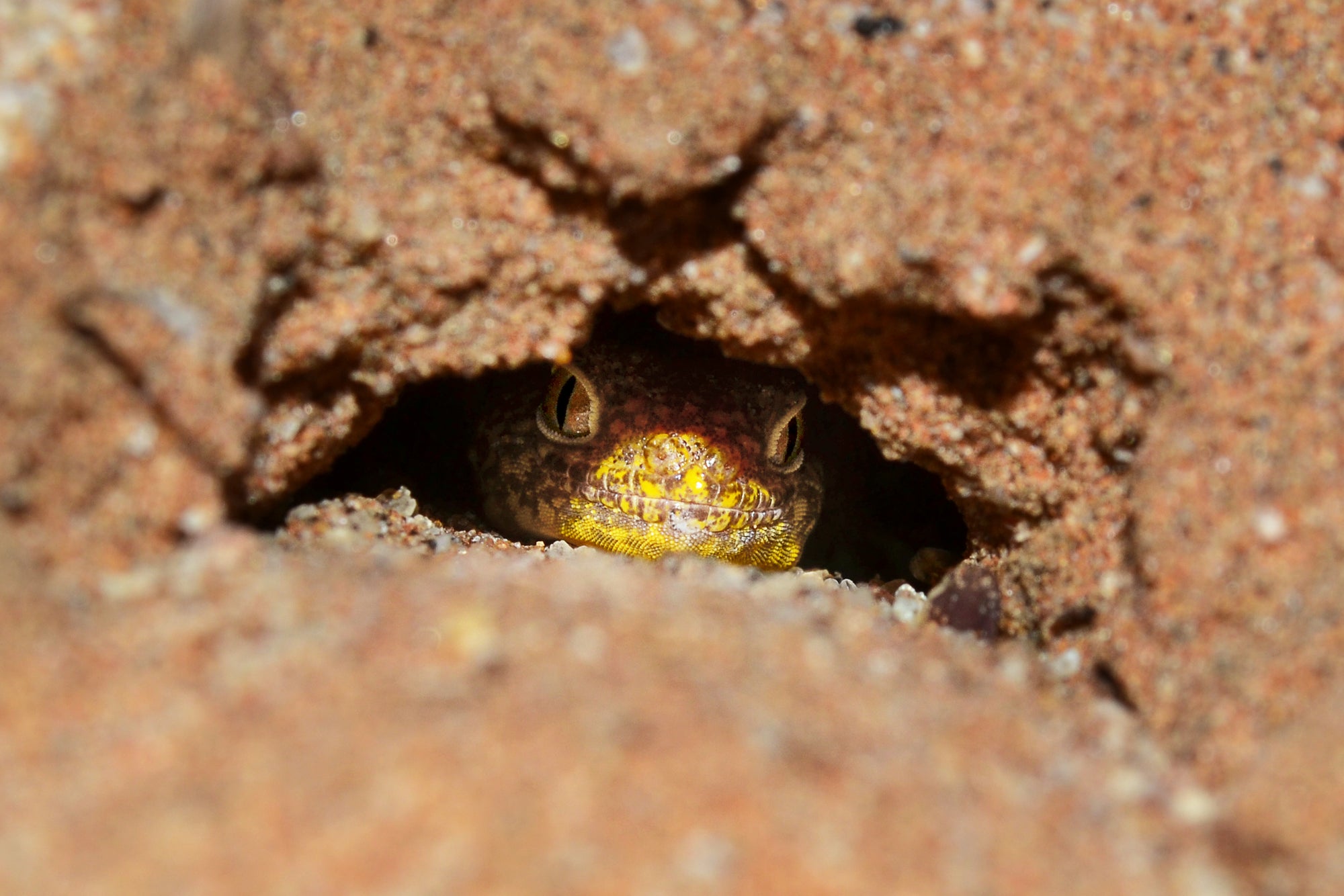
Ptenopus kochi.
François Becker
That’s why zoologists have shifted away from identifying species based mainly on physical traits and toward using what is called integrative taxonomy, where several pieces of evidence are used to decide on classifying new species, says Aaron Bauer, a gecko expert at Villanova University, who was not involved in the research but was a reviewer for the paper and an examiner on Becker’s Ph.D. committee. “This paper is an excellent example of this, with morphology, color, calls and DNA sequence data all being used to support the authors’ decisions,” Bauer says.
Now that the geckos are properly classified, scientists can more accurately assess their distribution patterns, habitat preferences and physical traits. “Anything we do in biology requires that we understand what species we are talking about,” Bauer says. “We would come to the wrong conclusions if we lumped two or more species under one name.”
Becker and other scientists are keen to ensure barking geckos continue to thrive. “They’re weird and very cute, just an adorable and quite interesting little group,” he says. “I think they deserve a bit of extra attention.”