
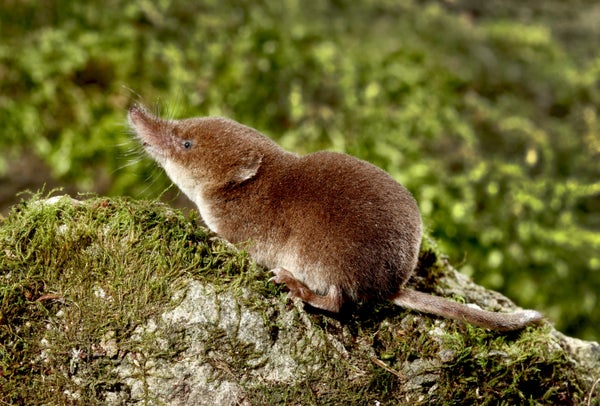
Shrews might seem rather unassuming. Smaller than mice, they can go largely unnoticed—scurrying through the grasslands of Britain, northern Europe and many parts of the U.S. in search of insects or dodging the hovering threat of owls and eagles.
Yet new research reveals these little molelike mammals are biological marvels when it comes to enduring the hardships of winter. A new study published Monday in Current Biology reports the skulls of Sorex araneus, the most common shrew species, shrink by up to 20 percent as the cold season approaches. Come spring, their heads return to roughly normal size.
Working in the 1940s, Polish zoologist August Dehnel first recognized shrews’ bodies shrink during winter, a finding that came to be known as the “Dehnel phenomenon.” But the new research is the first to nail down more specifics, and to measure the extent of the creatures’ head shrinkage by following individual animals through the seasons. The work suggests declining temperatures trigger shrews to literally break down their cranial bones and warm weather cues them to rebuild.
On supporting science journalism
If you're enjoying this article, consider supporting our award-winning journalism by subscribing. By purchasing a subscription you are helping to ensure the future of impactful stories about the discoveries and ideas shaping our world today.
To conduct the new study, lead author Javier Lazaro, a PhD candidate at Max Planck Institute for Ornithology, and his colleagues trapped 12 shrews in the nearby town of Möggingen, Germany. The animals were anesthetized, x-rayed and implanted with microchips for later identification. They were then scanned at regular intervals for over a year. All 12 showed the same pattern of peak head size in summer, a reduction throughout the winter and regrowth in the spring.
It is not just the skulls that shrink with winter, however. Shrews’ brains appear to get smaller, too—by as much as 30 percent, according to prior dissection research. Moreover, the animals’ other organs also lose mass; even their spines get shorter. Overall, the latest study suggests shrew body mass drops by 18 percent from July to February. Then, in spring, the creatures start to grow until they reach their peak size—83 percent larger than their winter low.
Shrews are not the only creatures to undergo bodily changes in response to environmental cues, scientists note. “It's not unusual for animals to lose soft tissue mass during lean periods,” says John Grady, a postdoctoral researcher in ecology at Michigan State University who was not involved in the study. “In addition to fat, some animals will lose organ mass when food is scarce.” He points to the fact some snakes break down their digestive tracts between feedings and build them back up after nabbing prey. But, like the authors of the new research, he was surprised by the degree of shrews’ shrinking bones and brains.
A shrinking skull may indicate bone is being reabsorbed by the body in the winter and regenerated in spring, according to Lazaro and his co-authors. They think gaining a better understanding of the proximate causes of that breakdown may help advance studies of degenerative bone diseases including osteoporosis. For now, however, they see the animals’ diminished bone, brain and body mass as an alternative to hibernation or migration. When food is scarce during winter, weight reduction likely saves the animals energy, the researchers say. “Shrews are fascinating,” Lazaro adds. “They are among the smallest mammals on the planet and have by far the highest relative metabolic rate among mammals.”
“Their hypothesis that brains shrink to reduce energy is very reasonable,” Grady says of the new study. “But one thing I wish they’d done is try to tease apart whether the shrews’ brains shrunk simply because they were too big for the newly shrunken body or if shrews are actually [able] to compromise brain function to save energy.”
Further research by Lazaro may soon help answer that question. He and his colleagues hope to build a large outdoor enclosure to better study how a shrinking brain influences shrews’ mental skills like learning, flexibility and memory. The goal, he says, is to help illuminate the relationship between their mammalian brains, body metabolism and environment. As Grady puts it, “Maybe the shrews get a little dimmer during the winter—and that’s the price of not starving to death.”