
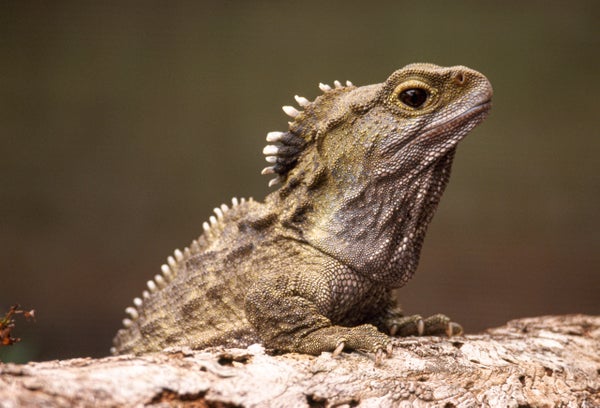
Earth is crawling with lizards and snakes. More than 10,000 species of these reptiles, called squamates, have adapted to thrive across almost every continent. But this vast assortment took a surprisingly long time to develop, according to University of Bristol paleontologist Jorge Herrera-Flores and his colleagues. Instead of trying new adaptations as quickly as possible, squamates succeeded by evolving with a relatively slow and steady pace, the researchers say—an idea counter to many biologists’ assumptions about how and why life generates diversity.
The researchers charted squamates’ evolution in a new study published in Palaeontology, contrasting them with elusive reptilian relatives called rhynchocephalians. Today the latter are represented by just one living species—New Zealand’s tuatara—but there were far more in the deep past. “For many decades,” Herrera-Flores says, “it has been questioned what was the real cause of the decline of the rhynchocephalians.”
The researchers observed a strange pattern: the two groups’ evolutionary trajectories were flipped. Squamates evolved differences in body size slowly during the first two thirds of the group’s existence, from about 240 million to 80 million years ago. At the same time, rhynchocephalians were rapidly splitting into a profusion of different sizes—until their diversity collapsed.
On supporting science journalism
If you're enjoying this article, consider supporting our award-winning journalism by subscribing. By purchasing a subscription you are helping to ensure the future of impactful stories about the discoveries and ideas shaping our world today.
Until now, it had seemed that quick bursts of evolutionary experimentation built long-term staying power. Previous studies of two other reptile groups, dinosaurs and crocodiles, proposed that fast early evolution helped these animals shoulder out competitors and quickly dominate the landscape. By that logic, rhynchocephalians’ speedy variations should have presaged greater success. Instead, Herrera-Flores and his colleagues suggest, fast evolution might create a kind of volatility that leads more readily to extinction. Squamates’ slower pace resulted in a more stable history, followed by a later burst of diversity when tuatara relatives were already on their downturn.
Reptiles are not alone in this apparent “slow and steady” strategy. Even though modern bony fishes are much more diverse today, a previous study found that in the past they were not as numerous or varied as holosteans—the prehistoric relatives of today’s gar and paddlefish. Such studies suggest that quickly diversifying to fill more niches is not always a route to long-term success.
And unlike its cousins, the specific rhynchocephalian lineage that led to today’s tuatara had “exceptionally low rates of evolution,” notes Harvard University herpetologist Tiago Simões, who was not involved in the new study. This is what makes the tuatara stand out as a “living fossil,” an echo of an ancient evolutionary boom that eventually went bust.