

The following essay is reprinted with permission from The Conversation, an online publication covering the latest research.
Experts have long understood that snakes can feel sound vibrations through the ground – what we call “tactile” sensing – but we’ve puzzled over whether they can also hear airborne sound vibrations, and particularly over how they react to sounds.
On supporting science journalism
If you're enjoying this article, consider supporting our award-winning journalism by subscribing. By purchasing a subscription you are helping to ensure the future of impactful stories about the discoveries and ideas shaping our world today.
In a new paper published in PLOS ONE, we conclude snakes use hearing to help them interpret the world, and finally dispel the myth that snakes are deaf to airborne sound.
Our research, which included 19 different snakes from seven species, reveals that not only do snakes have airborne hearing, but that different species react differently to what they hear.
How snakes respond to airborne and ground-borne sounds
Although seeing and tasting (the air) are the main ways snakes sense their environment, our study highlights that hearing still plays an important role in snakes’ sensory repertoire.
This makes sense from an evolutionary perspective. Snakes are susceptible to predators including monitor lizards, cats, dogs and other snakes. Hearing is an important sense for both predator avoidance and injury avoidance (such as being trodden on).
For our experiments, we collaborated with the Queensland University of Technology’s School of Creative Practice to fit-out a soundproof room and test one snake at a time.
Using silence as our control, we played one of three sounds, each including a range of frequencies: 1–150Hz, 150–300Hz and 300–450Hz. For comparison, the human voice range is about 100–250Hz, and birds chirp at about 8,000Hz.
In one previous study, researchers hung western diamondback rattlesnakes (Crotalus atrox) in a steel mesh basket and observed their restricted behaviours in response to sound frequencies between 200Hz and 400Hz. In another, researchers surgically implanted electrodes into the brains of partially anaesthetised snakes, detecting electrical potentials in response to sound up to 600Hz.
But our research is the first to investigate how multiple snake species respond to sounds in a space where they can move freely. We also used an accelerometer to detect whether the sounds produced ground vibrations. In this way we confirmed the snakes were indeed registering airborne sounds, and not just feeling ground vibrations.
Do snakes move toward or away from sound?
Most of the snakes exhibited very different types of behaviours in sound trials compared to the control.
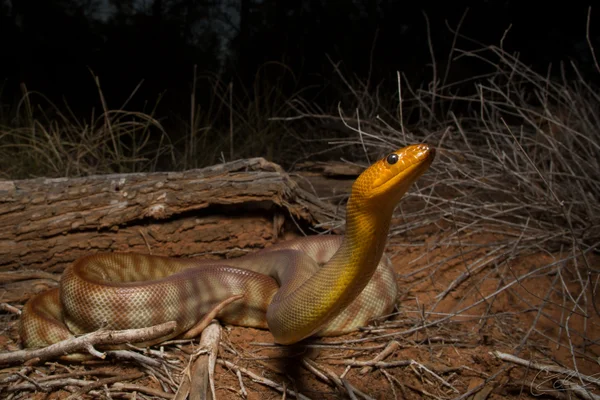
Woma pythons (Aspidites ramsayi) – a non-venomous snake found throughout Australia’s arid interior – significantly increased their movement in response to sound and actually approached it. They exhibited an interesting behaviour called “periscoping”, in which snakes raise the front third of their body in a manner that suggests curiosity.
In contrast, three other genera – Acanthophis (death adders), Oxyuranus (taipans) and Pseudonaja (brown snakes) – were more likely to move away from sound, signalling potential avoidance behaviour.
Death adders are ambush predators. They wait for their prey to come to them using the lure on their tail (which they wiggle to look like a worm), and they can’t travel quickly. So it makes sense they trended away from the sound. For them, survival means avoiding being trodden on by large vertebrates such as kangaroos, wombats or humans.
Brown snakes and taipans are active foragers that rapidly pursue their prey during the day. This means they may be vulnerable to daytime predators such as raptors. In our experiments, both of these snakes appeared to have acute senses. Taipans in particular were likely to display defensive and cautious behaviours in response to sound.
Can snakes hear us?
Our study further debunks the myth that snakes are deaf. They can hear – just not as well as you or I. Snakes can only hear low frequencies, roughly below the 600Hz mark, whereas most of us can hear a much wider range. Snakes probably hear muffled versions of what we do.
So, can snakes hear us? The frequency of the human voice is about 100–250Hz, depending on sex. The sounds we played in our trials included these frequencies, and were played at a distance of 1.2m from the snakes at 85 decibels. This is about the amplitude of a loud voice.
The snakes in our study responded to this sound, and many significantly so. So it’s probably safe to say snakes can hear people speaking loudly or screaming. That doesn’t mean they can’t hear someone talking (a normal conversation is about 60 decibels) – we just didn’t test sound at this noise level.
This article was originally published on The Conversation. Read the original article.