
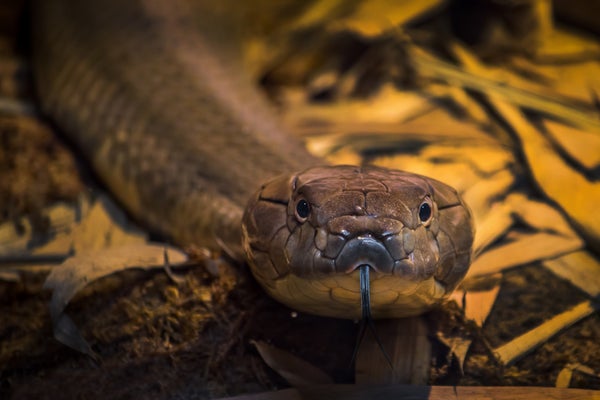
King cobras, the world’s longest venomous snakes, are popping up in parts of India where they have no business being—and it turns out they may be inadvertently boarding trains to get there. In addition to alarming passengers in something of a real-life spin of the 2006 movie Snakes on a Plane, the reptiles can end up in places where they can’t survive and, if antagonized, may pose a potentially fatal threat to humans.
Reports of king cobras and other snakes found in railway stations, or wrapped around and even inside trains, have been on the rise in India. In 2017 Dikansh Parmar of the Leibniz Institute for the Analysis of Biodiversity Change in Germany, rescued an Indian cobra (Naja naja) coiled around a train’s window bars that was hissing and, understandably, frightening passengers. “It was very afraid of people. It inflated its hood and tried to show that ‘I’m bigger than you’ to scare everyone,” Parmar says. “I just gently pulled it down, and then I caught it.”
In a study published January 26 in Biotropica, Parmar and his colleagues aimed to see how snakes were ending up so far from home. They used climate models to map the suitable habitat for the Western Ghats king cobra (Ophiophagus kaalinga), a snake newly recognized as its own species in 2024 and found in the state of Goa. Of the 47 places Western Ghats king cobras were rescued across the state between 2002 and 2024, five were completely unsuitable locations, including one snake found in a port city around 120 kilometers away by train from its natural range. All five outliers were found within a few hundred meters of railway tracks or stations.
On supporting science journalism
If you're enjoying this article, consider supporting our award-winning journalism by subscribing. By purchasing a subscription you are helping to ensure the future of impactful stories about the discoveries and ideas shaping our world today.

The Western Ghats King Cobra that emerged from beneath a pile of railway tracks stored at Chandor station for ongoing railway maintenance and repair.
Sourabh Yadav; from Parmar et al., doi.org/10.1111/btp.70157; CC by 4.0
These king cobras prefer the cool, rainy montane forests along Goa’s eastern border, not the dry, lowland western part of the state, says study co-author Hinrich Kaiser, a herpetologist at Victor Valley College in California. “They need to have a certain amount of moisture to incubate eggs,” he says.
Sometimes trains stop for days to collect goods or because of rains, the researchers say, which may give the snakes an opportunity to hop on. Why they would do so is unknown, though they may be hunting other snakes or rodents, or seeking shelter, the researchers suggest, then settling down on the trains to digest.
The idea proposed in the paper is intriguing but extremely hard to test, says Emily Taylor, a biologist at California Polytechnic State University, who wasn’t involved in the research. “This is what good science does—provides a strong hypothesis that we can continue testing as new evidence accumulates,” she says. Tracking the cobras with transmitters or genetically matched distant populations could provide some of this evidence, the authors suggest.
Thankfully, though king cobras are lightning fast and have a strong venom, they are unlikely to attack humans unless cornered or provoked, Kaiser says. “You are not food, so they much prefer to get out of your way.”