
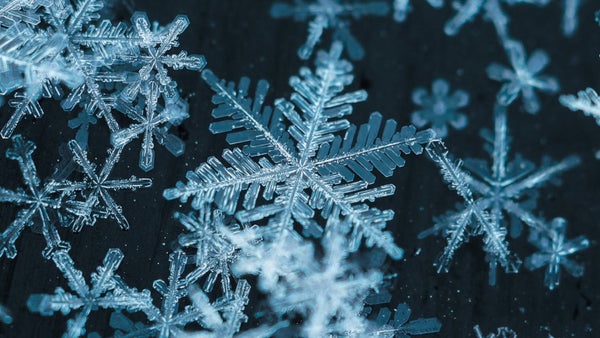
For all snowflakes' infinite structural variation, their journeys to Earth are remarkably similar—even predictable. Researchers tracking more than half a million falling flakes have uncovered a broad mathematical pattern that describes precisely how they swirl through the air.
University of Utah atmospheric scientist Tim Garrett, senior author of a new study in Physics of Fluids, has studied snowflakes for nearly a decade. Although the behavior of such tiny, ephemeral objects may seem inconsequential, their fall speed is a key variable in forecasts of weather and climate, even in the tropics; most precipitation, regardless of where it eventually ends up, begins as snow.
Snowflake movement is typically studied in laboratories under controlled conditions that don't reflect the complexity of nature. Scrutinizing falling snowflakes in the field has challenged atmospheric scientists for decades.
On supporting science journalism
If you're enjoying this article, consider supporting our award-winning journalism by subscribing. By purchasing a subscription you are helping to ensure the future of impactful stories about the discoveries and ideas shaping our world today.
For a new approach, Garrett teamed up with University of Utah engineers Dhiraj Kumar Singh and Eric Pardyjak to build a machine that measures the mass, density, area and shape of individual snowflakes that land on a hotplate. By placing this instrument underneath video cameras and a plane of laser light, the researchers could track how each snowflake moved in response to outdoor air turbulence.
“We were able to let the atmosphere express itself, to behave in a way that was completely uncontrolled by a scientist,” Garrett says. “I think that's why we ended up uncovering an extraordinary simplicity, an elegance.”
The researchers discovered a linear correlation between a snowflake's average acceleration—which, in this study, is equivalent to how much it swirls—and its Stokes number, a value that describes how quickly an object responds to changes in air turbulence. For instance, a wide and fluffy flake swirls more than a streamlined one.
Using the Stokes number, researchers can now predict how much a single snowflake will swirl as it falls. On a broader scale, the team was surprised to find that the distribution of average snowflake swirliness fits a single, nearly perfect exponential curve—a fixed mathematical pattern—despite the wide variability of air turbulence and range of snowflake shapes and sizes.
The cause of this regularity remains a mystery for now. But Garrett says that it could be related to how turbulent air prompts snowflakes to fluctuate in shape and size—which in turn can tweak their responses to that turbulence.
Further research is needed to assess the mathematical pattern's universality, says University of Minnesota mechanical engineer Jiarong Hong. “We will look into the applicability of [this result] to our data sets of snowflakes captured under different conditions,” including varied altitudes and ground roughness, he adds.
If the pattern does hold universally, “the fact that there's this simplicity suggests there's going to be a simple explanation,” Garrett says. “We just have to find it.”