
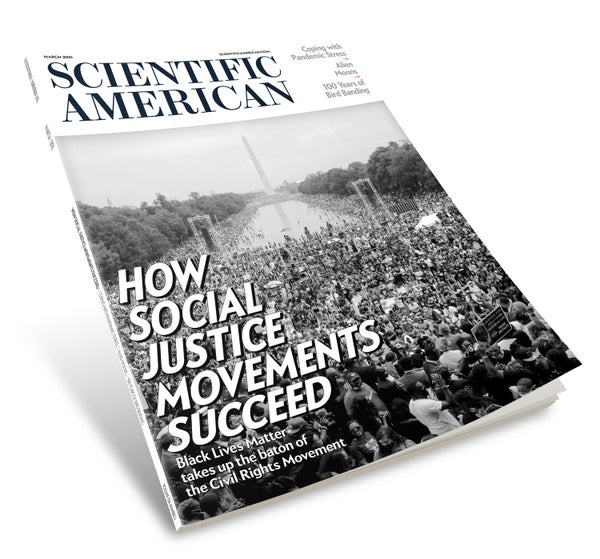
In our powerful cover story this month, sociologist Aldon Morris explains how social justice movements succeed. When the Civil Rights Movement began, some social scientists were dismissive of activists and described protests as unthinking mobs. Morris and his colleagues conducted immersive interviews with leaders of the Civil Rights Movement and similar struggles against injustice around the world and found that meticulous planning, cultural resources, discipline and creativity powered the movements, along with emotions ranging from righteous indignation to empathy and love. The Black Lives Matter movement has taken the baton from the Civil Rights era, and as Morris points out, “these struggles necessarily (and excitingly) continue to evolve faster than social scientists can comprehend them.”
One of the first great cities of the world was established about 7000 B.C.E. and lasted for 2,000 years. Çatalhöyük wasn't organized around marketplaces or monuments; people who lived there were homebodies who conducted work and rituals within their houses, which they entered through the ceiling. Author Annalee Newitz (who also writes fantastic science-fiction novels) shares what archaeologists have learned about the metropolis, including what people there ate and how they warmed their beds.
Astronomers are getting close to identifying the first exomoons—moons orbiting exoplanets in distant solar systems. They have a few candidates already, and science writer Rebecca Boyle explains how they are honing their instruments to detect subtle signals of a moon's influence on its host planet. Our own moon stabilizes our climate and influenced how life evolved—and exomoons could show us whether such a partnership is common throughout the galaxy.
On supporting science journalism
If you're enjoying this article, consider supporting our award-winning journalism by subscribing. By purchasing a subscription you are helping to ensure the future of impactful stories about the discoveries and ideas shaping our world today.
Last December the Hayabusa2 spacecraft completed its complex and ambitious mission to bring samples of an asteroid back to Earth. The pieces of the asteroid Ryugu could answer stubborn questions about the origins of our solar system, including how chondrules were made. These seedlike “droplets of fiery rain” are found in most meteorites, and astronomers have been speculating for centuries about how they were created: by lightning, or shock waves, or planet formation. Science writer Jonathan O'Callaghan shares the theories and the excitement about understanding these mysterious tiny drops.
Many of us at Scientific American are birders, some for decades and some who have taken up the hobby during the pandemic. The more you learn about birds, the more fascinating they are, and much of what we know about their migrations, life spans, and breeding and wintering ranges comes from a century of bird banding. Senior editor and newly converted birder Kate Wong, with graphic artist Jan Willem Tulp and illustrator Liz Wahid, highlights the discoveries that have come from this simple methodology. The research is ongoing—if you ever see a bird (alive or dead) with bands on its legs or wings, please report the band's code to the U.S. Geological Survey.
We hope you're faring as well as possible through the COVID pandemic and are able to get access to a vaccine soon if you haven't already. As the catastrophe enters its second year, science writer Melinda Wenner Moyer shares some evidence-based advice for coping through long-term disasters. We're really looking forward to publishing future stories about how the world recovers from all the challenges to physical, economic and mental health.