
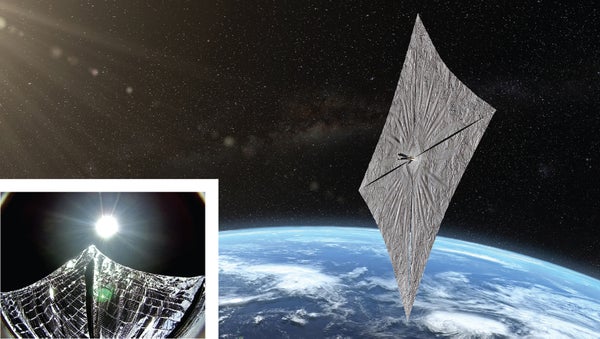
There are no gas stations in space. To send affordable, lightweight spacecraft on long-range missions, NASA and several aerospace companies are seeking ways to exploit the power of sunlight. Possibilities include reflective “sails” billowed by the sun's rays, as well as next-generation solar electric propulsion. In the coming months a privately backed project called LightSail 2 plans to launch a lunch box–size craft into orbit, where it will deploy a Mylar sail about as big as two parking spaces. If successful, these technologies could propel future NASA missions to Mars and beyond.
Solar sails are not science fiction—in 2010 Japan's IKAROS probe demonstrated a proof of concept during an interplanetary mission to Venus. Proponents say the technology used in the planned $5.45-million LightSail 2 demonstration, funded by the nonprofit Planetary Society, could maneuver low-cost satellites called CubeSats in Earth orbit without fuel. LightSail 2's performance could also inform NASA's Near-Earth Asteroid (NEA) Scout solar sail mission, scheduled to launch in 2019.
“The real niche [for solar sails] is for very small payloads that have long duration [and] low thrust requirements,” says Les Johnson, principal investigator for technology for the NEA Scout mission at NASA's Marshall Space Flight Center in Huntsville, Ala. Steady sunlight pressure—equivalent to less than one ounce of push per acre of sail—can gradually accelerate a small probe. And tilting the sail steers the spacecraft by changing the angle at which sunlight reflects off it, Johnson explains. The technology is ideal for relatively cheap missions with tiny payloads that can take their time, such as NEA Scout's planned reconnaissance of an asteroid.
On supporting science journalism
If you're enjoying this article, consider supporting our award-winning journalism by subscribing. By purchasing a subscription you are helping to ensure the future of impactful stories about the discoveries and ideas shaping our world today.
By the time sunlight reaches the vicinity of Jupiter's orbit, it is too weak for most solar sail–powered missions. But Jeffrey Sheehy, chief engineer of NASA's Space Technology Mission Directorate in Washington, D.C., and Johnson agree that the technology could potentially pave the way for interstellar missions, in which powerful lasers could accelerate sail spacecraft to a tenth the speed of light or faster. One private effort, called Breakthrough Starshot, hopes to send such craft on a flyby mission to Alpha Centauri, the star system nearest Earth, within a generation.
Sunlight could also drive much larger robotic or crewed spacecraft indirectly via solar electric propulsion, Sheehy says. Solar panels can provide electrical power for fuel-efficient thrusters that convert gas into plumes of plasma that propel the spacecraft.
NASA has already recruited companies such as Aerojet Rocketdyne and Ad Astra Rocket Company to scale up the power output of these systems. “Right now we fly solar electric propulsion systems that are just a few kilowatts,” Sheehy says. “What [we're] trying to do is [get] to a few tens of kilowatts as a stepping-stone to a few hundreds of kilowatts.”