New Issue: Orbital Catastrophe Ahead? Read Now

Solutions from Science

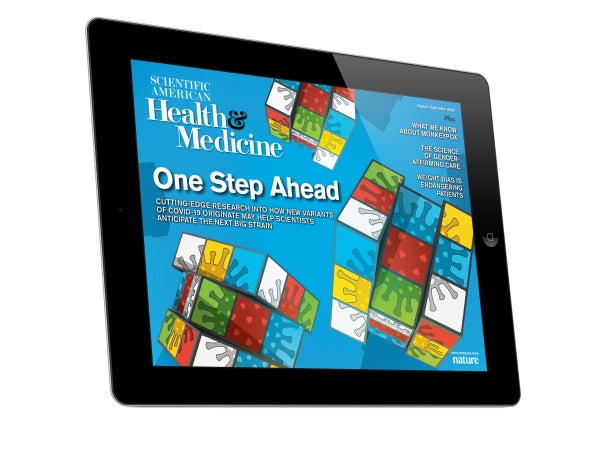
Scientific American Health & Medicine, August/September 2022

Join Our Community of Science Lovers!


On supporting science journalism

If you're enjoying this article, consider supporting our award-winning journalism by subscribing. By purchasing a subscription you are helping to ensure the future of impactful stories about the discoveries and ideas shaping our world today.


Another month, another variant. As of July, the version of SARS-CoV-2 called BA.5 is officially the dominant strain in the U.S., making up 54 percent of all new cases. This is unlikely to be the last variant, and each new strain, this one in particular, is highly contagious and has its own set of mutations that help it evade the immune system and existing antibodies from previous infections or vaccinations. Despite a constantly changing landscape, one thing that has remained steady since the beginning of this long pandemic is that science is ever vigilant. Researchers are studying past, present and long cases of COVID with unrelenting diligence, in hopes of perhaps predicting, if not preventing, the spread of the disease, as Ewen Callaway writes in this issue (see “Chronic Covid: The Evolving Story”).

Meanwhile new kinds of vaccines in development could revolutionize how we inoculate against the virus (see “Nose Spray Vaccines Could Quash COVID Virus Variants”), and engineers are at work implementing new ways to prevent indoor transmission (see “We Need to Improve Indoor Air Quality: Here’s How and Why”). Whether COVID sticks around for two more months or two more years, any solution we devise will be grounded, informed and inspired by science. And that, for me, is a cure for some uncertainty in the world.

Andrea Gawrylewski is chief newsletter editor at Scientific American. She writes the daily Today in Science newsletter and oversees all other newsletters at the magazine. In addition, she manages all special editions and in the past was the editor for Scientific American Mind, Scientific American Space & Physics and Scientific American Health & Medicine. Gawrylewski got her start in journalism at the Scientist magazine, where she was a features writer and editor for "hot" research papers in the life sciences. She spent more than six years in educational publishing, editing books for higher education in biology, environmental science and nutrition. She holds a master's degree in earth science and a master's degree in journalism, both from Columbia University, home of the Pulitzer Prize.

More by Andrea Gawrylewski
SA Health & Medicine Vol 4 Issue 4This article was published with the title “Solutions from Science” in SA Health & Medicine Vol. 4 No. 4 ()
doi:10.1038/scientificamerican082022-1igqhdNhsNKQTvDBg4unaO

Subscribe to Support Independent Journalism

Great science journalism requires human expertise, time, effort and creativity. And it costs money. That’s why I and the journalists here at Scientific American hope you’ll join our community.

When you subscribe, you are supporting staff and freelance journalists who are passionate about telling science stories that are true, important and compelling. Our editors and reporters are often experts in their fields, which means they understand the nuances of big discoveries and can untangle the breakthroughs from the hype. With a subscription, you are also supporting rigorous fact-checking to ensure the words we publish are precise and accurate. And you’re supporting original illustrations, graphics and photos that bring you closer to an advanced laboratory, an ice sheet in Antarctica or a space mission in orbit. You’re helping us craft other types of high-quality journalism as well: Our newsletters are carefully written, edited and curated by staffers you have or will come to know and love. Our Science Quickly podcast is based on original reporting, collaboration with editors and scientists and exacting production.

Subscriptions keep this engine running so we can continue to deliver thoughtful, rigorous and independent science journalism to you. In an era of viral misinformation, this work is crucial. If you value what we do, I hope you’ll consider joining us as a subscriber

Thank you,

Jeanna Bryner, Editor in Chief, Scientific American

Subscribe