
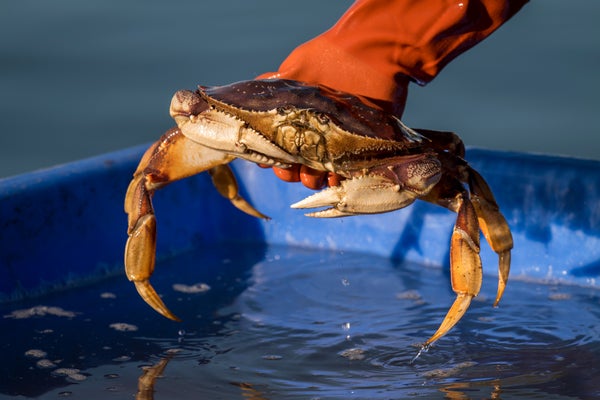
CLIMATEWIRE | New research has revealed an unexpected consequence of climate change. Some crabs are losing their sense of smell.
As more carbon dioxide seeps into the ocean and the water becomes more acidic, it's degrading one of the most important senses they use to find food. That could cause their populations to decline.
The study, published Tuesday in the journal Global Change Biology, focuses on the economically important Dungeness crab, which dwells up and down the West Coast of North America. Dungeness crabs make up some of the most valuable fisheries on the Pacific coast, including California, Oregon, Washington and Alaska.
On supporting science journalism
If you're enjoying this article, consider supporting our award-winning journalism by subscribing. By purchasing a subscription you are helping to ensure the future of impactful stories about the discoveries and ideas shaping our world today.
Yet Dungeness crab populations have declined in recent years. NOAA scientists blame an increase in algae blooms, low-oxygen water conditions and marine heat waves, among other factors. These stressors can be worsened by the influence of climate change.
Now, the new research reveals another threat.
As humans pour carbon dioxide into the atmosphere, some of it ends up absorbing from the air into the ocean. And as CO2 concentrations increase in the water, the ocean grows more acidic.
That’s bad for a wide variety of marine life. Numerous studies have found that ocean acidification damages corals and shellfish, making it harder for them to build and maintain the hard shells they need to survive. It can also alter the behavior of fish.
It can also make it harder for the Dungeness crab to detect important odors in the water.
Dungeness crabs have poor eyesight, so they rely strongly on their sense of smell to detect food and predators in the water. Each crab has a set of small, waving antennae that help them sniff out chemical signals in the water. When the crab encounters an important scent, it begins flicking its antennae faster to help it process the signal.
But the new study finds that ocean acidification interferes with this process. The researchers exposed groups of Dungeness crabs to two different kinds of environments — one with normal water conditions and one with elevated levels of carbon dioxide. They then pulsed the water with chemical signals intended to simulate the presence of a food source.
They found that crabs in the normal water environment flicked their antennae at higher rates when hit with the food smell, the way they should in their natural environment. But crabs exposed to higher levels of CO2 didn’t do so. In fact, the researcher had to hit them with about a ten times higher concentration of the food chemical before they responded.
When the researchers examined the antennae, they found that increased CO2 levels appear to interfere with the nerve response that prompts the faster flicking.
The researchers say it’s some of the first evidence that ocean acidification can affect a crustacean’s olfactory system.
It’s unclear at the moment how much of an influence the effect is having on Dungeness crab populations. But it could add to the list of climate-related factors already threatening the species.
“Losing their sense of smell seems to be climate related, so this might partially explain some of the decline in their numbers,” said Cosima Porteus, a scientist at the University of Toronto, Scarborough, and a co-author of the study, in a statement. “If crabs are having trouble finding food, it stands to reason females won’t have as much energy to produce eggs.”
Reprinted from E&E News with permission from POLITICO, LLC. Copyright 2023. E&E News provides essential news for energy and environment professionals.