
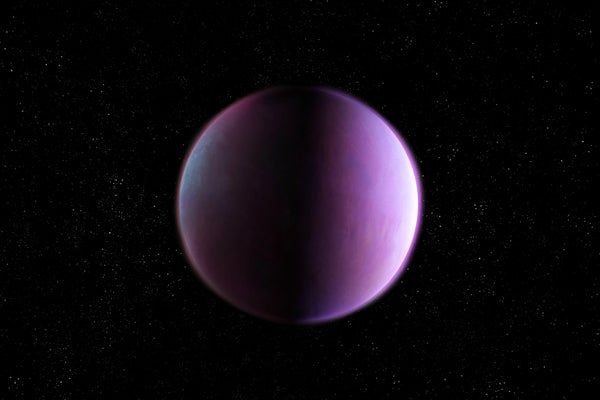
If we discover alien life, what will it look like?
We have no way of knowing, but the hunt for extraterrestrial life can now include purple bacteria, according to a group of astronomers who are recording the chemical makeup unique to the lavender-hued organisms. These microbes may have dominated Earth early on in our planet's history and are well-suited to emerge on faraway worlds that circle dim red stars smaller than our sun, a new study suggests.
The latest cataloging effort is in part "to create a database for signs of life to make sure our telescopes don't miss life if it happens not to look exactly like what we encounter around us every day," study co-author Lisa Kaltenegger of Cornell University said in a statement. "Purple bacteria can survive and thrive under such a variety of conditions that it is easy to imagine that on many different worlds, purple may just be the new green."
On supporting science journalism
If you're enjoying this article, consider supporting our award-winning journalism by subscribing. By purchasing a subscription you are helping to ensure the future of impactful stories about the discoveries and ideas shaping our world today.
On Earth — the only planet we know of where life exists and thus our best guide in the hunt for extraterrestrial life — life sustains itself on oxygen-producing photosynthesis driven by chlorophyll, the familiar green pigment utilized by most organisms to harness sunlight. This wasn't the case until roughly 2.4 billion years ago, when tiny blue-green algae called cyanobacteria, the first known species to photosynthesize, began using chlorophyll to harness sunlight and carbon dioxide for metabolic energy, and released oxygen as a byproduct.
Prior to that, microorganisms generated metabolic energy by harnessing sunlight using a purple-pigmented molecule called retinal, whose origin may have predated chlorophyll. If retinal exists on other faraway worlds, scientists think the molecule's unique fingerprint would be discernible by upcoming ground- and space-based telescopes.
"They already thrive here in certain niches," said study lead author Lígia Fonseca Coelho of the Carl Sagan Institute in New York. "Just imagine if they were not competing with green plants, algae and bacteria: A red sun could give them the most favorable conditions for photosynthesis."
The current search for alien life is biased toward looking for green pigments, primarily because of limited measurements of organisms of other colors including purple, Coelho and her team argue. To develop a catalog of the chemical makeup of purple organisms, the researchers grew purple bacteria collected from different places — including shallow pond waters at Cornell, Massachusetts's Cape Cod and deep-sea hydrothermal vents — and measured their unique fingerprints. In subsequent simulations, they modeled purple bacteria dominating a variety of Earth-sized planets, including ocean worlds, frozen icy orbs and terrestrial rocky spheres like Earth.
The virtual purple bacteria produced detectable biosignatures, providing astronomers a new data set to inform next-generation telescopes in the search for alien life, like the European Extremely Large Telescope being constructed in Chile and NASA's Habitable Worlds Observatory, an infrared telescope currently scheduled for launch around 2040.
"We are just opening our eyes to these fascinating worlds around us," said Kaltenegger. The findings are described in a paper published April 16 in the journal Monthly Notices of the Royal Astronomical Society: Letters.
Join our Space Forums to keep talking space on the latest missions, night sky and more! And if you have a news tip, correction or comment, let us know at: community@space.com.