
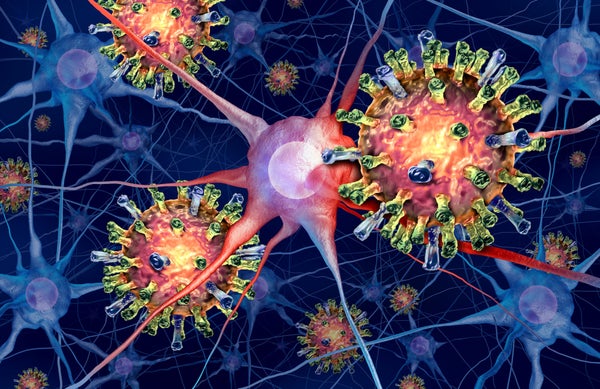
A straightforward case of measles is nasty—but the disease’s complications are even worse. One of those complications has been confirmed in the ongoing, record-breaking measles outbreak in South Carolina: encephalitis, or brain swelling.
South Carolina state epidemiologist Linda Bell confirmed the complication was occurring there during a media briefing on February 4, according to Wired. Bell did not specify the number of people who were affected or how serious their cases were.
Encephalitis occurs in about one of every 1,000 measles cases and kills about one in five people who develop it. The complication is not well understood but appears to be the result of the virus prompting the immune system to attack a certain protein that some brain cells produce.
On supporting science journalism
If you're enjoying this article, consider supporting our award-winning journalism by subscribing. By purchasing a subscription you are helping to ensure the future of impactful stories about the discoveries and ideas shaping our world today.
As of February 3, South Carolina had reported 876 cases of measles related to the outbreak in its upstate region. Most of those cases are in children who were not vaccinated against the disease. Since January 2025, nearly 3,000 people have been reported as infected with measles in the U.S., according to Johns Hopkins University’s independent tracking. The 2,267 cases that occurred in the U.S. last year represent the nation’s highest annual total since 1991. The virus’s continued spread is likely to end the 25-year streak in which measles has been officially deemed eliminated in the U.S., experts say.
Measles is a notoriously contagious virus, with each infectious person spreading it to an average of 15 people. The combined vaccine against measles, mumps and rubella is 93 percent effective after one dose and 97 percent effective after the recommended two doses. But the virus’s extreme infectiousness means that cases can rise rapidly where vaccination rates drop below 95 percent.
Even when someone appears to fully recover from measles, the virus can cause serious complications years after infection. It can trigger “immune amnesia” to other pathogens that the body has seen, apparently by attacking cells that the immune system uses to remember those germs.
Those infected in South Carolina who haven’t yet developed encephalitis may yet do so. In rare cases, the virus can lie dormant in the brain for 10 or 15 years, picking up genetic mutations until it is able to destroy neurons, causing a condition called subacute sclerosing panencephalitis, or SSPE, that is almost always fatal. A child in Los Angeles County died from SSPE in September 2025.