
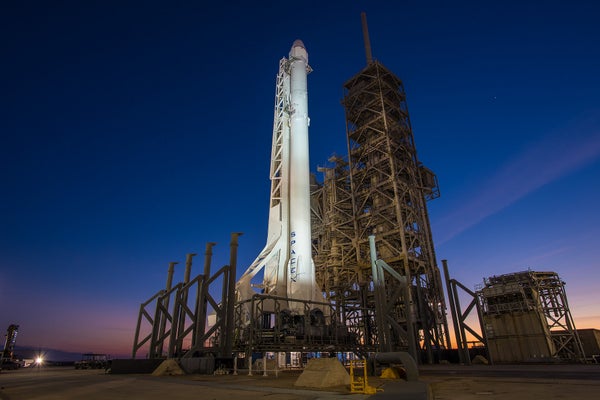
Elon Musk's company successfully launched a satellite to orbit today (June 23) using a pre-flown Falcon 9 booster, pulling off the feat for the second time in less than three months.
The action began at 3:10 p.m. EDT (1810 GMT), when the Falcon 9 blasted off from historic Pad 39A at NASA's Kennedy Space Center in Florida with the BulgariaSat-1 communications satellite on board.
About 2.5 minutes into the flight, the rocket's two stages separated, and the first stage began maneuvering its way back to Earth. About 8 minutes after liftoff, the booster made a pinpoint touchdown on the deck of a robotic SpaceX "drone ship" that was stationed off the Florida coast.
On supporting science journalism
If you're enjoying this article, consider supporting our award-winning journalism by subscribing. By purchasing a subscription you are helping to ensure the future of impactful stories about the discoveries and ideas shaping our world today.
Before the launch, Elon Musk warned via Twitter: "Falcon 9 will experience its highest ever reentry force and heat in today's launch. Good chance rocket booster doesn't make it back." But indeed it did, marking another successful stage recovery for SpaceX.
The mission was the second for the Falcon 9 first stage, which had previously launched and safely landed on Jan. 14. That launch sent 10 communications satellites into oribt for the Virginia-based company Iridium, for its planned 70-satellite Iridium NEXT constellation. The second batch of 10 satellites is currently scheduled to launch on a Falcon 9 from Vandenberg Air Force Base in California Sunday (June 25), making a weekend doubleheader for SpaceX.
Today, the Falcon 9's second stage — which was flying for the first time — did its job, continuing to power BulgariaSat-1 to orbit.
SpaceX first reused a Falcon 9 first stage on March 30, during the successfullaunch of the SES-10 communications satellite. That booster came back down to Earth for a second landing as well.
SpaceX now has 12 booster landings under its belt, as well as three total orbital re-flights — two of Falcon 9 first stages, and one of the robotic Dragon cargo capsule. A pre-flown Dragon delivered cargo to the International Space Station earlier this month, and will depart the orbiting lab (for the second time) in early July.
These activities are part of SpaceX's effort to develop and deploy reusable spaceflight systems, a key priority for Musk, who founded the company back in 2002. Such technology will slash the cost of spaceflight, potentially making Mars colonization and other ambitious exploration feats economically feasible, the billionaire entrepreneur has said.
BulgariaSat-1, which was built by the California company SSL, is the first Bulgarian-owned communications satellite. The craft will head to geostationary orbit, about 22,300 miles (35,800 kilometers) above Earth; from this perch, it will provide television and data-communications services to Bulgaria, the Balkans and other parts of Europe.
EDITOR'S RECOMMENDATIONS
SpaceX Drone Ship Cameras Capture Historic Used Rocket Landing | Video
In Photos: SpaceX Launches, Lands 1st Reused Falcon 9 Rocket
Copyright 2017 SPACE.com, a Purch company. All rights reserved. This material may not be published, broadcast, rewritten or redistributed.