
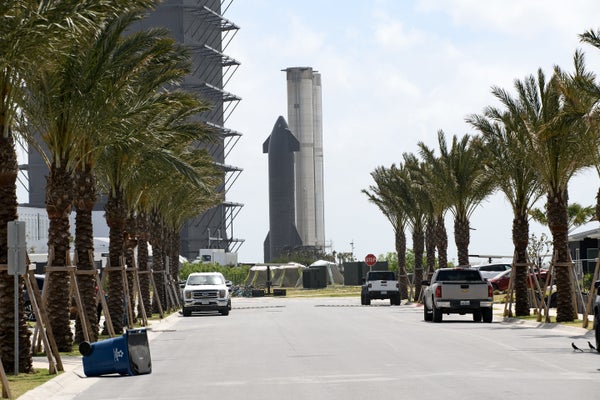
SpaceX's newest Starship vehicle just went up in smoke.
The company was testing a Starship upper stage at its Starbase site in South Texas on Wednesday night (June 18), to prepare for the megarocket's upcoming 10th flight test.
But something went very wrong, as video captured by NASASpaceflight.com shows: The vehicle exploded, sending a massive fireball high into the dark Texas skies.
On supporting science journalism
If you're enjoying this article, consider supporting our award-winning journalism by subscribing. By purchasing a subscription you are helping to ensure the future of impactful stories about the discoveries and ideas shaping our world today.
SpaceX acknowledged the incident in an X post early on Thursday morning (June 19), noting that it occurred around 11 p.m. local time (midnight EDT and 0400 GMT on June 19).
"A safety clear area around the site was maintained throughout the operation and all personnel are safe and accounted for," SpaceX added in the post. "Our Starbase team is actively working to safe the test site and the immediate surrounding area in conjunction with local officials. There are no hazards to residents in surrounding communities, and we ask that individuals do not attempt to approach the area while safing operations continue."
SpaceX is developing Starship, the biggest and most powerful rocket ever built, to help humanity colonize Mars, among other ambitious exploration tasks.
The vehicle consists of two elements, both of which are designed to be fully and rapidly reusable — a first-stage booster called Super Heavy and a 171-foot-tall (52 meters) upper-stage spacecraft known as Starship, or simply Ship.
It was Ship that exploded on Wednesday night, on a test stand at Starbase's Massey site (not the orbital launch mount, from which Starship liftoffs occur). According to NASASpaceflight, which closely monitors Starship activity at Starbase, the anomaly occurred just before Ship was set to perform a static-fire test.
Static fires are common prelaunch tests, in which a rocket's engines are briefly ignited while the vehicle remains anchored to the ground. SpaceX had already conducted a static fire with this Ship, though that trial involved just one of its Raptor engines; this test may have been intended to fire up all six of them.
SpaceX has also already static-fired the Flight 10 Super Heavy booster, successfully igniting all 33 of its Raptors.
Wednesday night's explosion continued a string of setbacks for Starship upper stages. Ship has broken apart on the last three Starship test flights, which launched in January, March and May of this year.
On Flight 7 and Flight 8, the "rapid unscheduled disassembly" occurred less than 10 minutes after liftoff. Ship flew significantly farther on Flight 9; SpaceX lost contact with the vehicle about 46 minutes after liftoff, and its pieces are likely resting on the Indian Ocean seabed.
Super Heavy has performed better. On Flight 7 and Flight 8, for example, the booster returned to Starbase after launch for a dramatic catch by the launch tower's "chopstick" arms. The Flight 7 Super Heavy flew again on Flight 9, notching a major reusability milestone for the Starship program. (SpaceX did not attempt to recover the booster on Flight 9, and it broke apart as it was coming in for a planned "hard splashdown" in the Gulf of Mexico.)
SpaceX is still looking into what happened on Flight 9, an investigation overseen by the U.S. Federal Aviation Administration. So there was not yet an official target launch date for Starship Flight 10 — and, if there had been, it would now have to be revised after the events of Wednesday night.
Copyright 2025 Space.com, a Future company. All rights reserved. This material may not be published, broadcast, rewritten or redistributed.