
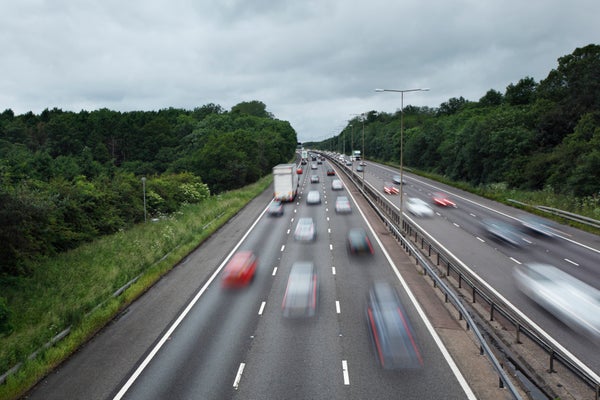
By adding just one minute to their daily car commutes, U.S. drivers could be saving more than $20 million—and preventing nearly 60,000 metric tons of carbon dioxide emissions—every day, a new study finds.
The fact that speeding increases fuel use isn’t new, says study co-author Will Northrop, a professor of mechanical engineering at the University of Minnesota. As a car speeds up, the air resistance pushing against it increases and forces the engine to work harder, using more fuel to achieve the same speed. But we hadn’t put numbers to this effect, which is where Northrop’s team and a dataset of car trajectories from the U.S. came in.
“What’s unique about our work and what motivated us was that we had availability of this very large dataset, which allowed us to really understand the real impact of the vehicle trajectories and speeding on fuel economy,” he says.
On supporting science journalism
If you're enjoying this article, consider supporting our award-winning journalism by subscribing. By purchasing a subscription you are helping to ensure the future of impactful stories about the discoveries and ideas shaping our world today.
The team used a raw dataset collected from vehicle manufacturers that tracked the locations and speeds of cars all over the country every three seconds on four separate days at different points of the year. From there, the researchers mapped the locations onto speed limits and studied the vehicle trajectories; they anonymized the specific GPS coordinates after they made the speeding calculations.
Out of 120 million trips, 43.2 percent included some speeding. Using a supercomputer, Northrop’s team modelled a hypothetical version of each trip without speeding—an intimidating data processing task that took years.
When the authors extrapolated their findings to an entire year of driving, they estimated that by forgoing speeding, drivers would have saved $22 million per day, based on 2021 gas prices. In a recent analysis adjusted for 2026 gas prices, the daily cost rose to $26 million.
Though the study, published on Thursday in Communications Sustainability, emphasizes the “sheer magnitude of the savings on a daily basis,” Northrop says, further research questions remain. His team is curious about the fuel effects of acceleration and aggressive driving and other air pollutants that might increase with speeding. This study also doesn’t account for the real-life circumstances around speeding, such as traffic patterns, he adds, which can make it more difficult to stop the habit altogether.
“We don’t have a social solution; we’re engineers,” Northrop says. “We’re putting the data out there for people to know that this is what speeding causes.”