
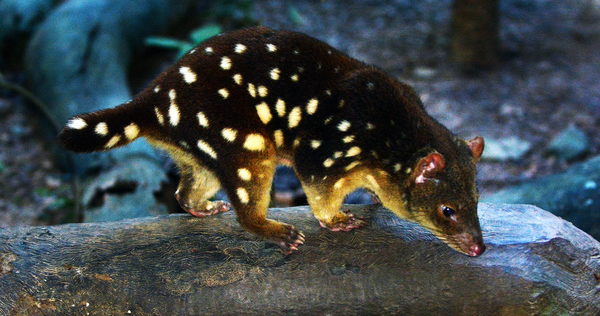
On an island off Australia’s north-central coast, researchers are conducting an unprecedented experiment: mixing endangered animals that have evolved genetic defences against their biggest foe with those that haven’t, in the hope that their offspring will take after the wiser parent.
The subject of the experiment is one of Australia’s most imperilled marsupials, the northern quoll (Dasyurus hallucatus). This squirrel-sized carnivore is struggling to survive a decades-long onslaught of poisonous and invasive cane toads, which quolls mistake as prey, with devastating results. The team now working on Indian Island has successfully tested the match-making technique in captive-bred quolls, and reported the results last month in Conservation Biology.
If a further study now underway in wild animals is successful, it could provide some of the first real-world evidence that targeted gene flow—which involves pushing an adaptive trait through an at-risk population to boost resiliency—could be used to save an endangered species.
On supporting science journalism
If you're enjoying this article, consider supporting our award-winning journalism by subscribing. By purchasing a subscription you are helping to ensure the future of impactful stories about the discoveries and ideas shaping our world today.
Australia, which has the highest mammal extinction rate in the world, is desperate for new conservation tools, says Euan Ritchie, a wildlife ecologist at Deakin University in Melbourne. The quoll research is exciting, he says, because it “provides hope we can still achieve conservation wins, even for the most challenging and pressing of situations”. If targeted gene flow works—the real test will be the ongoing wild trial—the research team says it could help other threatened species, too, including Tasmanian devils and corals on the Great Barrier Reef.
Toad invasion
In the 80 years since agriculture officials introduced the cane toad (Rhinella marina) to northeastern Australia to control a sugar cane-devouring beetle, the amphibians have spread across the state of Queensland, the Northern Territory and large chunks of Western Australia. Their rapid advance has devastated northern-quoll populations, which have shrunk by more than 75%.
Ecologists Ella Kelly and Ben Phillips knew from their previous research that some quoll populations in Queensland had developed an aversion to the toads over the years. The researchers, both at the University of Melbourne, wondered whether the trait could be successfully bred into vulnerable quoll populations that cane toads hadn’t yet reached. That could make those 'naive' quolls more resilient to toad invasions, if enough animals in a given group have the trait.
To test this idea, the scientists bred animals in captivity, mixing northern quolls from a toad-infested area of Queensland that displayed an aversion to toads with naive quolls from a toad-free island in the Northern Territory. Kelly and Phillips then exposed the resulting offspring to a toad leg to gauge whether the young quolls recognized the threat. They found that most of the young quolls wouldn’t touch the toad legs.
The finding suggests that the trait is inherited, rather than taught by mother quolls, and may be dominant, the researchers say. “That’s the first hurdle that needs to be jumped in showing targeted gene flow,” Phillips says. “Without a genetic basis, there is no point in introducing [toad-smart quolls] into the population. And we found there is a genetic basis."
The captive-quoll study is an important step towards demonstrating that targeted gene flow is a viable strategy to aid quoll conservation, says Sarah Fitzpatrick, a conservation biologist at Michigan State University’s Kellogg Biological Station in Hickory Corners. "Many behaviours are plastic, and therefore are not necessarily controlled by certain genes,” she says. “If this were the case for toad-eating behaviour, targeted gene flow would not work.”
An island test
Buoyed by the results of the captive study, Kelly and Phillips, along with University of Melbourne colleague Chris Jolly, decided in May 2017 to see whether toad-smart and naive quolls would produce toad-smart offspring in the wild. They released 54 quolls on toad-infested Indian Island—a mix of naive Northern Territory quolls, toad-averse quolls from Queensland and hybrid offspring.
When the researchers returned in April this year to check on the quolls, they found good and bad news. Far fewer quolls survived than the team had anticipated—just 16 animals, according to the researchers’ population estimate. But encouragingly, the group included offspring that seem to be toad-smart, which would suggest that they inherited the trait from their parents. The team is now analysing genetic samples taken from the survivors.
Kelly and Phillips plan to return to the site again next April to see how the remaining quolls fare. “It will be a long wait,” they write in a draft report on the project.
As the experiment continues, the pair is seeking permission from wildlife officials in Western Australia to introduce northern quolls with the toad-smart trait into populations in the path of the cane toad diaspora to gird them against future invasions. “We have a very strong case that there is absolutely nothing to lose and a lot to gain,” Phillips says. “It would be a tragedy not to try.”
This article is reproduced with permission and was first published on July 23, 2018.