
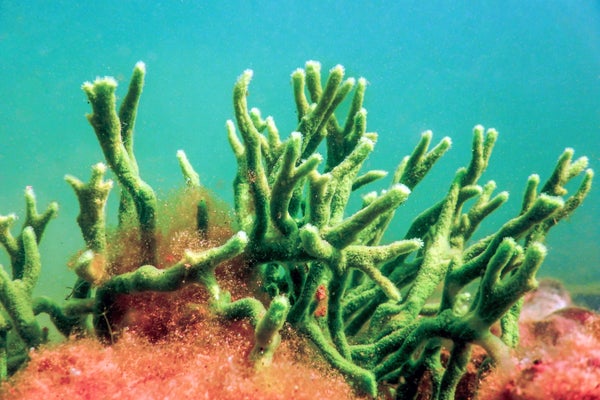
Sponges are simple creatures, yet they are expert filter feeders, straining tens of thousands of litres of water through their bodies every day to collect their food. Their mastery of this complex behaviour is all the more remarkable because they have no brain, nor even a single neuron to their name.
A study published on 4 November in Science now reveals that sponges use an intricate cell communication system to regulate their feeding and to potentially weed out invading bacteria. The findings could help to understand how animals’ nervous systems evolved, says Casey Dunn, an evolutionary biologist at Yale University in New Haven, Connecticut, who studies marine invertebrates. “This is a really exciting study that allows us to see sponges in a new light,” he says.
Cells frequently communicate with one another, and neurons do so by passing electrical or chemical signals through tiny, targeted connections called synapses. Previous research has found that sponges possess genes encoding proteins that typically help synapses to function, despite the animals’ lack of neurons.
On supporting science journalism
If you're enjoying this article, consider supporting our award-winning journalism by subscribing. By purchasing a subscription you are helping to ensure the future of impactful stories about the discoveries and ideas shaping our world today.
To discover which cells were expressing these genes, Detlev Arendt, an evolutionary biologist at the European Molecular Biology Laboratory (EMBL) in Heidelberg, Germany, and colleagues sequenced the RNA in various individual cells from a freshwater sponge (Spongilla lacustris).
They found that the sponge has 18 distinct cell types. Synaptic genes were active in a few of these types, which were clustered around the sponges’ digestive chambers. This suggests that some form of cellular communication might coordinate the animal’s filter-feeding behaviour.
The researchers then used X-ray imaging and electron microscopy to study one of these cell types, which they called secretory neuroid cells. The scans revealed that neuroids send out long arms to reach choanocytes, a type of cell with hair-like protrusions that drive sponges’ water-flow systems and capture most of their food.
Nervous-system precursor
On the basis of the proximity of the two cell types and the expression of genes that might allow for the secretion of chemicals, the researchers think that these arms enable neuroids to communicate with choanocytes, so that they can pause the water-flow system and clear out any debris or foreign microbes. However, these neuroid cells are not nerves, and there is no sign of the synapses that enable neurons to communicate so quickly. Instead, this cell type might represent an evolutionary precursor to a true nervous system, says Jacob Musser, an evolutionary biologist at EMBL, who co-authored the study. “We’re at an intermediate point, where you’ve gone from having all these independent pieces to bringing them together more broadly, but you haven’t gotten all the interconnectivity needed to create a fast synapse,” he says.
Some scientists say that calling these cells a precursor to a nervous system is a stretch. “It’s tantalizing, but it’s hardly definitive,” says Linda Holland, an evolutionary developmental biologist at the University of California, San Diego. She says it will be difficult to prove whether nervous systems evolved from this cellular communication system or arose earlier or even multiple times, as some groups have proposed. Indeed, many other organisms, including unicellular eukaryotes, contain the same synaptic genes, says Sally Leys, a marine biologist at the University of Alberta in Edmonton, Canada.
April Hill, a developmental geneticist at Bates College in Lewiston, Maine, hopes that scientists will use this study and its methods as a “launchpad” for further investigation of this ubiquitous sponge. Whether other sponges use a similar cellular communication system, she adds, remains a key unanswered question.
This article is reproduced with permission and was first published on November 5 2021.