
Cities by their nature are hotspots for invasive species: all the coming and going means that countless newbie plants and animals regularly face the gamble of natural selection. Most newcomers fade out or establish only a small population, but every so often a species explodes on the scene and becomes problematic.
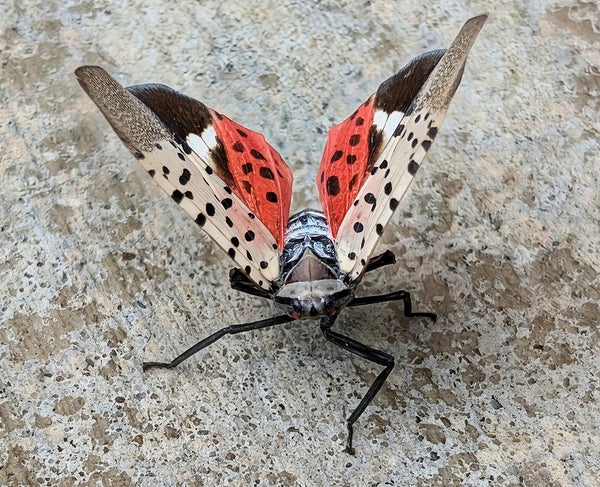
Perhaps no species has made quite as splashy an entrance as the spotted lanternfly (Lycorma delicatula), which in the past decade has stormed mid-Atlantic cities in massive flurries of polka-dotted wings. Although they’re more of an economic threat in the countryside, where they’re particularly damaging to grapevines, new research shows it’s likely not a coincidence they’re succeeding at city life, too.
For Kristin Winchell, an evolutionary ecologist at New York University, the spotted lanternfly’s arrival in New York City in July 2020 was serendipitous. She wanted to test a hypothesis called anthropogenically induced adaptation to invade: the idea that landscapes that humans have reshaped worldwide—cities being the most extreme examples—are ecologically more like one another than natural ecosystems are. So species adapted to local urban areas may more easily invade a distant one.
On supporting science journalism
If you're enjoying this article, consider supporting our award-winning journalism by subscribing. By purchasing a subscription you are helping to ensure the future of impactful stories about the discoveries and ideas shaping our world today.
Spotted lanternflies seemed a plausible example; in the U.S., they were first detected about an hour’s drive from downtown Philadelphia in 2014, and today their spread tracks the web of cities from Greensboro, N.C., to as far north as Boston and as far west as Detroit, with sightings scattered as far as Chicago, Cincinnati, Nashville and Atlanta.
Winchell and her colleagues gathered spotted lanternflies from across the invaded territory, as well as from urban and rural locations in their native Shanghai, and dug into the animals’ genes. They confirmed that the U.S. population of the bugs stems from a single introduction, as researchers had suspected, which created a distinctive “bottleneck” in the species’ genetic diversity. The details were reported in the Proceedings of the Royal Society B.

The thriving city life of spotted lanternflies is no coincidence.
Gary Hershorn/Getty Images
More intriguing, the scientists detected the signatures of two previous bottlenecks in the population that went on to spread in the U.S.—one about a decade earlier, likely triggered by the lanternfly’s original invasion of South Korea, and another about 170 years ago. This older bottleneck coincided with Shanghai’s urbanization. Moreover, the researchers found key genes related to toxins in the modern Shanghai lanternflies collected in urban areas but not in those from natural forests. The genes might have helped the bugs develop a foothold in urban environments long before any arrived in the U.S.
“The fact that they landed in the largest contiguous metropolitan region in the U.S. was probably really important to their rapid spread here,” Winchell says. “If you get on a train in Baltimore and take that up to Boston, there are many, many places along the way where you could hop off and you’re going to still be in the city,” she adds. “It gives them a lot more opportunities to disperse into habitats that they are adapted to.”
Other research has shown that in the U.S., urban spotted lanternflies are growing larger than rural ones, meaning they’re potentially able to travel farther on relatively larger energy stores, produce more offspring or better withstand hot temperatures—suggesting their evolution is continuing apace.
The spotted lanternfly’s story is a warning that biologists need to pay attention to what’s happening in cities and other places heavily shaped by humans before an invasion starts, says Julie Urban, an evolutionary biologist at Pennsylvania State University, who was not involved in the analysis.
Urban, who specializes in the broader group of plant hoppers to which the spotted lanternflies belong, is one of few in the U.S. who knew about the insects before they arrived. The more than 12,000 described species of plant hoppers worldwide offer stunning biological oddities: some grow a cluster of tail-like wax spikes out their rear; others have heads shaped like a cashew nut or a shrew’s long, button-tipped nose. (The spotted lanternfly’s strangest trait may be that females can somehow rearrange their internal anatomy to pass their microbiome on to their eggs, Urban says.)
In the wild, plant hoppers are usually hard to find: even in hotspots, Urban says, you may find only a few individuals of a few species. That’s hard to imagine now in cities where the spotted lanternfly has really spread its wings, and crowds of adult lanternflies are unmissable. Urban has spent more than a decade watching the insects skyrocket to fame. “It’s been very strange, but I think that’s why I feel a sense of obligation to help,” she says. “This is my first invasive.”
The cities being hardest hit by the spotted lanternflies can’t make the same claim. Take New York City, which is only a few years into hosting the bugs. A decade before, a different invasive insect landed in the Big Apple. Nicknamed the ManhattAnt before eventually being identified as the European Lasius emarginatus, the ant now lays claim to three in every four ant colonies in the city, says Ellen van Wilgenburg, a behavioral ecologist at Fordham University.
The ManhattAnt moves fast, climbs high and can tolerate the hot city streets, all of which have let it outcompete the city’s native ants—without most of the city’s human residents even realizing. “They don’t get any attention, because no one cares about ants,” van Wilgenburg says. Even scientists aren’t keeping up, with only a handful of papers examining the species, compared with dozens about spotted lanternflies in the U.S.
Spotted lanternflies’ celebrity status, then, might turn out to be a boon for the science of invasive species, particularly in cities, Winchell says: “I think it could become a model system for really understanding how invasions proceed over time, how they become endemic and how they interact with the native environments.”