
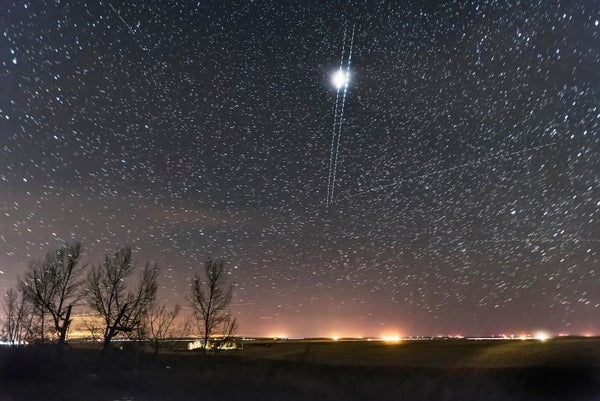
There’s a space battle brewing just under our noses (and above our heads).
On one side are astronomers who use ground-based observatories to gather starlight from the depths of the universe. On the other are technologists, military planners and captains of industry who are rapidly cocooning our planet in ever growing swarms of starlight-spoiling satellites.
When a satellite passes through the view of a ground observatory, it can reflect sunlight back to the telescope, creating bright streaks in the resulting pictures that can obscure—or even masquerade as—astrophysical phenomena. This is especially problematic for state-of-the-art facilities such as the new Vera C. Rubin Observatory, which uses giant mirrors and the world’s largest digital camera to capture ultrahigh-resolution panoramic views of the sky from a remote mountaintop in Chile. It’s a “collision of two beautiful technologies,” says Tony Tyson, the Rubin Observatory’s chief scientist and an astronomer at the University of California, Davis.
On supporting science journalism
If you're enjoying this article, consider supporting our award-winning journalism by subscribing. By purchasing a subscription you are helping to ensure the future of impactful stories about the discoveries and ideas shaping our world today.
As the satellites increase in number, with proposals for more than a million new ones currently pending, tensions are rising between those who see the sky as a wellspring of cosmic knowledge—and others who view it as a new, scarcely tapped realm of economic activity.
There are currently more than 13,000 spacecraft orbiting Earth, and more than half of them are satellites built, launched and operated by SpaceX as part of the company’s sprawling Starlink megaconstellation. Starlink exists to fill the lingering gaps in global Internet connectivity, offering high-speed broadband service to customers essentially anywhere on Earth—and while it’s by far the biggest player in this domain, it’s not the only one.
Others include Amazon’s Project Kuiper (with more than 3,200 planned satellites), Eutelsat’s OneWeb (with nearly 650 satellites) and a host of Chinese projects such as Guowang, Qianfan, and Honghu-3 which each call for thousands of satellites. There’s even a Starlink spin-off, Starshield, custom-built by SpaceX for the U.S. Department of Defense. Starlink’s dominance makes it the poster child for megaconstellations, however—the chief target of astronomers’ ire and the test case for carving out a peaceful coexistence. (In response to a request for comment, a representative from SpaceX pointed to regular updates on the company’s website.)
From the beginning, Starlink engineers collaborated with astronomers to reduce the optical impacts of their satellites. Their first-generation design used dark materials and sun visors to absorb more sunlight and reduce visibility of the satellites from Earth. But the sun visors created too much drag and were scrapped in the second-generation design. In the satellites’ second iteration, instead of having them absorb the light, SpaceX focused on strategically reflecting it away from Earth using a dielectric mirror film on any flat surfaces. The second-generation satellites also used a specially developed black paint to reduce the possibility of glints from other components where possible.
In a recent preprint paper posted on arXiv.org, the co-authors, who included Tyson and two SpaceX employees, analyzed the impact of these developments on the optical interference of the satellites and found that they reduced the optical interference, though even more improvements could be made.
While the Starlink satellites typically operate at a height of around 550 kilometers, Tyson and his colleagues also simulated the satellites’ optical interference in orbits as low as 350 km. In the simulations, the lower altitude resulted in about a 40 percent reduction in the number of satellites entering the view of the telescope, with only a 5 percent increase in brightness (objects that are higher up can be viewed from Earth at more locations and remain in the telescope’s view for longer periods).
But making a satellite orbit too low can cause undue trouble for the operators, Tyson says. A satellite in very low-Earth orbit experiences more atmospheric drag, which, if not counteracted, will hasten its orbital decay and subsequent atmospheric reentry. At this time, the Rubin Observatory’s official recommendation remains that satellites orbit below 600 km, rather than at some much lower altitude.
The International Astronomical Union’s Center for the Protection of the Dark and Quiet Sky from Satellite Constellation Interference (IAU CPS) has been reaching out to various satellite companies asking them to reduce their optical (as well as radio) interference. “Most of the folks that we’ve talked to that I’ve interfaced with have actually been pretty open,” says Meredith Rawls, an astronomer at the University of Washington and a co-leader of the IAU CPS’s SatHub initiative, “but it doesn’t scale.” CPS can’t possibly reach out to all the relevant players to raise concerns and continue to follow up about their proposed solutions and their impacts. On top of that, even companies that are receptive to the CPS’s concerns may not be willing to make significant changes—such as lowering satellite orbits—that would harm their bottom line.
To broadly and consistently protect the astronomical sky, governing bodies may need to pass restrictive policies. “I don’t think anyone wants zero satellites,” Rawls says, “but at the moment, it is a pretty unregulated kind of Wild West situation that we find ourselves in.” Initiatives such as the U.S. National Science Foundation’s (NSF’s) satellite coordination agreements, where government agencies broker deals directly with satellite operators, could be a happy medium. So far, the NSF has signed deals with U.S. satellite companies such as Project Kuiper, OneWeb, Starlink and AST SpaceMobile to ensure these companies follow certain guidelines and avoid, to the extent possible, interfering with partner observatories.
One complication is that astronomical observations are not only affected by satellites produced in the countries they’re based in. “No single nation or entity can drive meaningful change without the coordinated action and cooperation of governments, satellite owner-operators or manufacturers, and astronomers from around the world,” wrote the United Nations Committee on the Peaceful Uses of Outer Space (COPUOS) in a conference room paper. COPUOS has yet to propose any regulations or standards for broad adoption. Instead it has recommended that member nations encourage and support collaborations between satellite manufacturers and astronomers. With growing numbers of satellite operators worldwide, however, experts believe this may not be enough.
Rubin and similar observatories are “still going to do good science,” Rawls says. She describes the optical interference from satellites as “bugs on the windshield”: difficult and irritating—not devastating. Tyson describes the interference more like bright headlights from an approaching car, obscuring important details with a burst of light. The legacy of the Rubin Observatory, he says, will be to “discover the unexpected”—to find things in space that astronomers never knew to look for that will “blow everybody’s mind.” But these discoveries are made less likely by the “foreground haze” of satellite constellations. “The scientific community will be giving up something,” Tyson says. “I hope it isn’t too much.”