
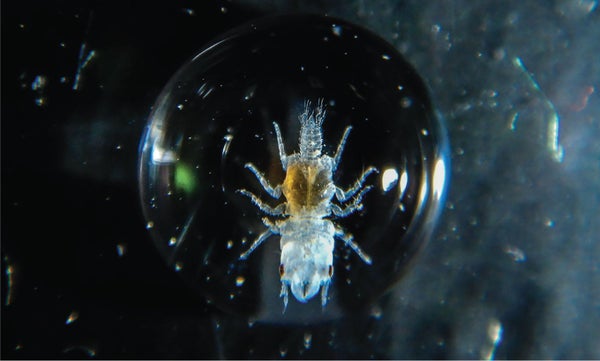
Just after researchers wrapped up fieldwork for the season in the turquoise waters between the Virgin Islands and Puerto Rico in 2017, back-to-back major hurricanes tore through their study sites and laboratories. It was a serious setback in the team's work with little-known parasites called gnathiids, whose young latch onto saltwater fish and feed on their blood.
But the misfortune also presented a rare opportunity to study how catastrophic hurricanes impact marine animal populations, says molecular ecologist Juan Andrés Pagán, a graduate student at the University of Porto in Portugal and lead author on a recent study in Scientific Reports. Every year since 2013, the team—which calls itself Gnathiid Gnation—had collected a species it named for Bob Marley (Gnathia marleyi), found in coral reefs. After the hurricanes the researchers returned to collect more specimens. They braved jellyfish and sharks to set traps for the gnathiids, which are most active at night.
For their new study, the scientists sequenced gnathiid DNA from population samples collected at the various sites before and after the hurricanes, which were the most intense consecutive storms to hit the area in decades. “We were able to pretty clearly establish that, prior to the hurricanes, these populations were stable,” Pagán says, meaning the parasites remained in the same isolated areas year after year.
On supporting science journalism
If you're enjoying this article, consider supporting our award-winning journalism by subscribing. By purchasing a subscription you are helping to ensure the future of impactful stories about the discoveries and ideas shaping our world today.
After the storms, things changed.
Gnathiids are bad long-distance swimmers. Under normal conditions they stick to small areas, similar to other invertebrates such as crustaceans and mollusks. But G. marleyi rode the 2017 hurricanes over unusually long distances, with some apparently traveling more than 250 kilometers. The researchers found that this displacement led to a “mixing of the pool” and, in turn, a more genetically similar gnathiid population, says team leader Paul Sikkel, an Arkansas State University marine ecologist and study co-author. “The hurricanes homogenized all that,” Sikkel says. “At any one site the diversity became higher. But overall [the populations] became more even because things were being moved around.” This may be the first clear, genetics-based evidence that hurricanes affect the genetic diversity of a marine species, he says.
“The kicker here for me is climate change,” says Richard Aronson, a marine biologist at the Florida Institute of Technology, who was not involved in the study. If hurricanes increase in intensity as predicted, Aronson says, the study suggests there may be more genetic homogenization among some marine animals that would otherwise remain in isolated populations. This would make peripheral populations less likely to cleave off and create new species, he adds.
The researchers are also investigating whether the parasites spread blood-borne pathogens that could harm fish populations. If that is the case, Sikkel says, this study may illustrate the potential for parasite-borne disease outbreaks in the wake of future major hurricanes.