New Issue: Orbital Catastrophe Ahead? Read Now

Stranded Chinese Astronauts Return to Earth, but Space Junk Threats Remain

The Shenzhou 20 spacecraft was too damaged to bring its crew home from China’s Tiangong space station. Those astronauts have now returned via the Shenzhou 21 craft, leaving its crew without a return ride until the nation sends a new spacecraft to the station

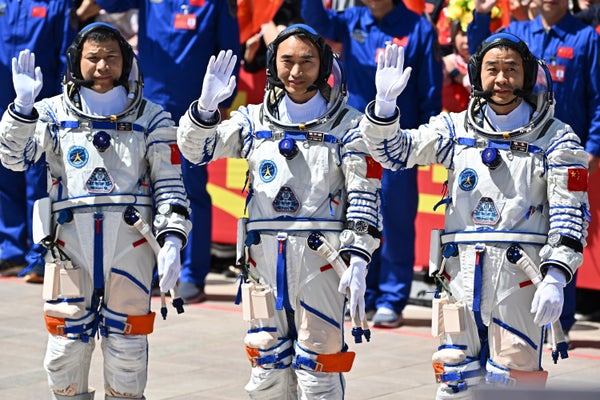
Three astronauts pause and wave in a large crowd

Astronauts for China’s Shenzhou 20 space mission Wang Jie, Chen Zhongrui and Chen Dong wave before boarding a bus to take them to the Shenzhou 20 spaceship on April 24, 2025.

Pedro Pardo/AFP via Getty Images

Join Our Community of Science Lovers!

Three Chinese astronauts who had been stranded for days in space after a suspected piece of space junk hit their spacecraft are back on Earth, the China Manned Space Engineering Office (CMSE) announced on Friday.

The agency also revealed that it had found tiny cracks in one of the windows of the crew’s Shenzou 20 return capsule—rendering it unusable.

The astronauts instead returned onboard the Shenzhou 21 spacecraft, which had originally been used by Shenzou 20’s replacement crew. China had planned to keep the Shenzhou 21 capsule docked at its Tiangong space station to return those astronauts at the end of their mission, which is currently slated for April 2026.


On supporting science journalism

If you're enjoying this article, consider supporting our award-winning journalism by subscribing. By purchasing a subscription you are helping to ensure the future of impactful stories about the discoveries and ideas shaping our world today.


“I’m very glad that they got home, but it is a bit disconcerting that the replacement crew apparently does not have a vehicle to come back to Earth,” says Victoria Samson, chief director of space security and stability at the Colorado-based nonprofit Secure World Foundation.

CMSE told the Chinese news agency Xinhua that a new spacecraft, Shenzhou 22, will be launched at an “appropriate time in the future,” meaning that Tiangong’s remaining three-person crew currently has no means of returning to Earth in the event of an emergency.

It’s unclear what kind of debris struck Shenzhou 20, but Samson speculated that it was likely tiny—perhaps between one and 10 centimeters in diameter—which is too small for astronomers to track.

“This again underlines the argument for not deliberately creating debris in orbit,” Samson said.

Humberto Basilio is a Mexican science journalist covering policy, health, misconduct, archaeology and the environment. He is also a former news intern at Scientific American. His work has been published in the New York Times, National Geographic, Science, Nature, and more.

More by Humberto Basilio

Subscribe to Support Independent Journalism

Great science journalism requires human expertise, time, effort and creativity. And it costs money. That’s why I and the journalists here at Scientific American hope you’ll join our community.

When you subscribe, you are supporting staff and freelance journalists who are passionate about telling science stories that are true, important and compelling. Our editors and reporters are often experts in their fields, which means they understand the nuances of big discoveries and can untangle the breakthroughs from the hype. With a subscription, you are also supporting rigorous fact-checking to ensure the words we publish are precise and accurate. And you’re supporting original illustrations, graphics and photos that bring you closer to an advanced laboratory, an ice sheet in Antarctica or a space mission in orbit. You’re helping us craft other types of high-quality journalism as well: Our newsletters are carefully written, edited and curated by staffers you have or will come to know and love. Our Science Quickly podcast is based on original reporting, collaboration with editors and scientists and exacting production.

Subscriptions keep this engine running so we can continue to deliver thoughtful, rigorous and independent science journalism to you. In an era of viral misinformation, this work is crucial. If you value what we do, I hope you’ll consider joining us as a subscriber

Thank you,

Jeanna Bryner, Editor in Chief, Scientific American

Subscribe