
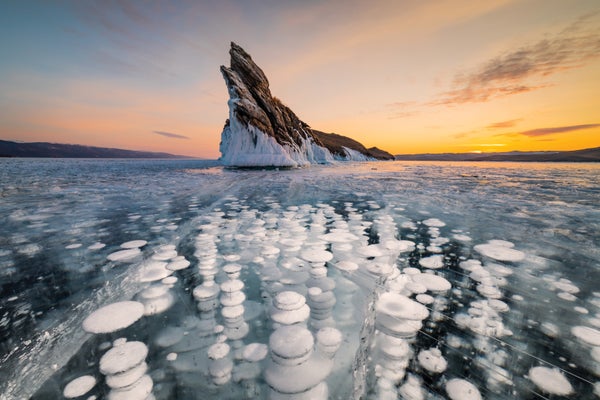
Look closely at an ice cube, and you might spot minuscule bubbles shaped like teardrops, flattened eggs or even winding worms. Bubble patterns in Russia’s Lake Baikal (shown here) are even more vivid. Researchers have found that ice bubbles’ peculiar shapes can reveal how fast the water froze and how much gas was dissolved in it, providing key insights for glaciologists and engineers.
As water freezes, most of its dissolved gases get expelled. But some tiny bubbles near the freezing edge can get trapped in the solidifying ice, where they keep growing. Virgile Thiévenaz, who studies fluid mechanics at Paris’s Industrial Physics and Chemistry Higher Education Institute, and Alban Sauret, a mechanical engineer at the University of California, Santa Barbara, re-created this process in the laboratory to tease apart the factors that affect growing bubbles’ shapes and sizes.
As Thiévenaz explained during a presentation at an American Physical Society meeting, the researchers observed that ice bubbles are never spherical but instead elongate in the direction of freezing. The researchers found that an ice sample hosting many small, slightly elongated bubbles suggests a high freezing rate and a high gas concentration, whereas a sample with a few larger, longer pores froze more slowly. These variations are predictable mathematically: “We can match most bubbles with the same equation,” Thiévenaz says. If you know a sample’s freezing rate, you can work out the gas concentration, and vice versa. Their equation predicts that long, cylindrical ice-bubble “worms” will sometimes grow unchecked, weakening the surrounding structure.
On supporting science journalism
If you're enjoying this article, consider supporting our award-winning journalism by subscribing. By purchasing a subscription you are helping to ensure the future of impactful stories about the discoveries and ideas shaping our world today.
Environmental ice tells a story about the past, but determining past freezing conditions is tricky. Thiévenaz and Sauret say that making inferences based on bubble shape could be a boon for researchers studying lake ice and glacier cores. Erin Pettit, a glaciologist at Oregon State University, agrees. “I’ve always been puzzled by the wormy bubbles in pockets of refreezing water within glaciers,” she says. “It’s exciting to see the physics behind their formation.”
Additionally, many engineers favor porous solids for certain applications because of their light weight. By controlling gas concentration and freezing speed, scientists could theoretically dictate a material’s pore shape, leading to strong and light metals, glasses and ceramics, the researchers suggest.