
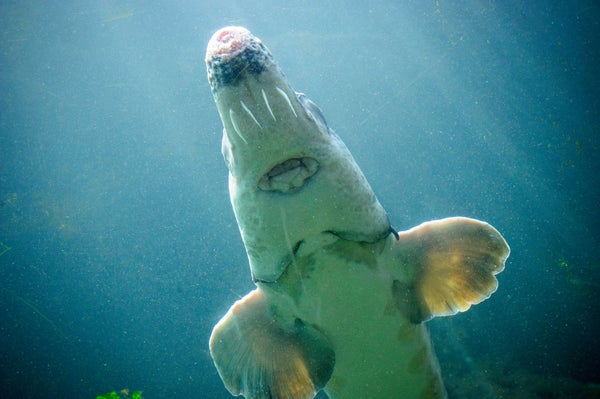
Atlantic sturgeon in the Hudson River in New York State generate low-frequency “thunder” sounds while mating, according to recent research. The findings could be used to help study declining populations of the endangered fish species.
Atlantic sturgeon are massive fish—an individual of the species can grow to about the same length as a Volkswagen Beetle and can weigh more than a parlor a grand piano. And these large animals apparently generate some rather grumbly mating events.
“It’s almost that you feel it more than you hear it,” said Maija Niemistö, a co-author of the study and a researcher at Cornell University’s New York State Water Resources Institute, in a statement.
On supporting science journalism
If you're enjoying this article, consider supporting our award-winning journalism by subscribing. By purchasing a subscription you are helping to ensure the future of impactful stories about the discoveries and ideas shaping our world today.
During spawning—or mating—a female sturgeon releases as many as two million eggs into the water, while males release milt, or fluid containing sperm. Scientists recorded “biological sounds” during these events in the Hudson, hearing what they describe as “thunders.” These are the first recordings of Atlantic sturgeon’s noisy mating, according to the authors—lake sturgeon, a separate species of fish, are known to make similar “thunder” sounds during spawning.
It’s unclear whether the sounds may be a form of sturgeon-to-sturgeon communication or simply the by-product of mating activity, the authors note. In hatcheries, male Atlantic sturgeon have been observed to “thrash against” females during the spawning process, the authors write.
This thrashing—and possibly the jiggling of the sturgeon’s swim bladder—could be generating the rumbling sounds, says Rebecca Cohen, lead author of the study and a postdoctoral researcher at the K. Lisa Yang Center for Conservation Bioacoustics at Cornell. But this is an “educated guess” based on other fish species’ behavior; more research is needed to confirm the exact reason for the thunders.
With more research, the results could prove useful for monitoring the species using sound, Cohen says—a strategy that enables environmental scientists to track sturgeon populations from afar. Further research could help reveal where spawning locations are or even how many individual fish might be present in a river.
“If we can use sounds to track when and where they’re spawning in the river, that’s a really crucial insight to inform management in these freshwater environments and protections,” Cohen says.