
Two tiny, hopping robots now have a companion on the surface of the big asteroid Ryugu.
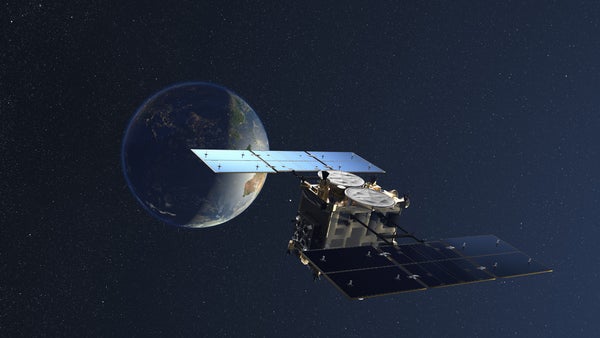
A shoebox-sized lander called the Mobile Asteroid Surface Scout (MASCOT) deployed from its mothership, Japan’s Hayabusa2 spacecraft, as planned at 9:57 p.m. EDT Tuesday (Oct. 2; 0157 GMT on Oct. 3) and came to rest on Ryugu shortly thereafter. The lander’s first photo of asteroid Ryugu shows a rocky world, and even MASCOT’s own shadow.
“It could not have gone better,” MASCOT project manager Tra-Mi Ho, from the DLR Institute of Space Systems in Bremen, Germany, said in a statement. (DLR is the German acronym for the German Aerospace Center, which built MASCOT in collaboration with the French space agency, CNES.) [Japan’s Hayabusa2 Asteroid Ryugu Mission in Pictures]
On supporting science journalism
If you're enjoying this article, consider supporting our award-winning journalism by subscribing. By purchasing a subscription you are helping to ensure the future of impactful stories about the discoveries and ideas shaping our world today.
“From the lander’s telemetry, we were able to see that it separated from the mothercraft and made contact with the asteroid surface approximately 20 minutes later,” Ho added.
MASCOT has already started gathering data with its four onboard science instruments—a camera, a radiometer, a spectrometer and a magnetometer—mission team members said. The 22-lb. (10 kilograms) lander must make haste, because its battery is expected to die just 16 hours after touchdown.
MASCOT took 20 photos during its slow descent toward Ryugu, and these images are stored aboard Hayabusa2 at the moment, mission team members said. And observations made by the magnetometer before separation (which occurred when Hayabusa2 was about 167 feet, or 51 meters, above Ryugu) have already made it down to Earth.
“The measurements show the relatively weak field of the solar wind and the very strong magnetic disturbances caused by the spacecraft,” MASCOT team member Karl-Heinz Glaßmeier, from the Technical University of Braunschweig in Germany, said in the same statement. “At the moment of the separation, we expected a clear decrease of the interference field—and we were able to recognize this clearly.”
MASCOT is following in the footsteps of MINERVA-II1A and MINERVA-II1B, two 2.4-lb. (1.1 kg) rovers that deployed from Hayabusa2 on the night of Sept. 21. Both of those little robots aced their touchdowns and soon began exploring the surface of Ryugu.
Like the Japanese-built MINERVA-II1A and MINERVA-II1B, the autonomous MASCOT can move by hopping, which it does by manipulating a metallic “swing arm” inside its body. The lander can also use this arm to right itself on Ryugu’s surface—an important feature, because MASCOT needs to be right side up to gather data and beam it up to Hayabusa2.
The $150 million Hayabusa2 mission launched in December 2014 and arrived in orbit around Ryugu in late June of this year. The mothership may have one more rover deployment to go: It still carries the “optional” hopper MINERVA-II2, which could make its way to Ryugu’s surface next year.
And the orbiter itself will make its way down to the space rock in 2019 as well, after sending a nonexplosive impactor barreling into Ryugu. Hayabusa2 will grab pristine, previously subsurface samples from the newly created crater; this material is scheduled to come down to Earth in a return capsule in December 2020.
Data gathered by the mission at Ryugu and by scientists who examine its returned sample should shed considerable light on the solar system’s early history and the role that carbon-rich asteroids like Ryugu may have played in life’s emergence on Earth, Hayabusa2 team members have said.
NASA has an asteroid-sampling mission of its own in operation, with broadly similar goals. The OSIRIS-REx probe is scheduled to arrive in orbit around the 1,650-foot-wide (500 m) asteroid Bennu on Dec. 31 and return samples to Earth in September 2023.
Copyright 2018 Space.com, a Purch company. All rights reserved. This material may not be published, broadcast, rewritten or redistributed.