
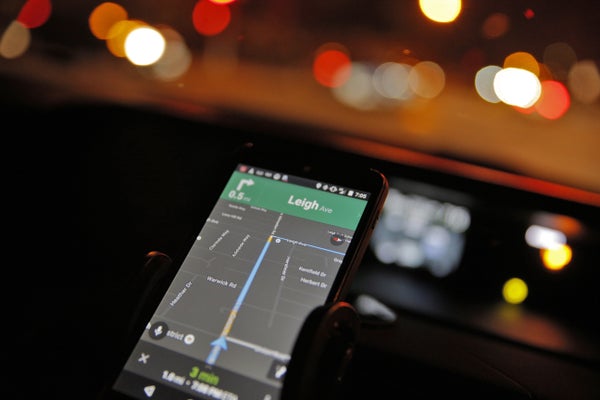
If you’re reading this on your phone, your device is almost certainly leaving a record of where it has been. Those records can reveal where you live and work, the restaurants you frequent and the medical offices or houses of worship you visit—and even which friends, or at least their phones, are moving alongside yours.
On Monday the Supreme Court acknowledged how revealing those location records can be. In Chatrie v. United States, a 6–3 majority held that the government conducts a Fourth Amendment search when it uses a geofence warrant to obtain location history. Such warrants reverse the logic of most investigations. Rather than beginning with a suspect, police draw a boundary around a place and time—say, the scene of a crime—and require a company to produce records of the devices it tracked there.
The ruling extends the logic of the Court’s 2018 decision in Carpenter v. United States, which ruled that individuals retain a privacy interest in the digital trail of their movements, even when that information is held by a third party. Now the Court has applied that reasoning to geofence warrants, which allow police to seek records for devices associated with a particular place and time. For anyone whose phone logs where it goes, this is the Supreme Court’s first limit on geofence searches, a form of surveillance that is growing cheaper and more precise every year.
On supporting science journalism
If you're enjoying this article, consider supporting our award-winning journalism by subscribing. By purchasing a subscription you are helping to ensure the future of impactful stories about the discoveries and ideas shaping our world today.
Google received its first geofence warrant in 2016, the Court's opinion states. Four years later it received more than 11,000. In 2019 police investigating a credit-union robbery in Virginia asked Google for anonymized location data from devices inside a 150-meter-radius circle around the building during a one-hour window. Google returned data for 19 users. Investigators narrowed the list, and Google eventually identified three people, including Okello Chatrie, whose location history helped lead to his arrest.
The company has since changed how its Location History feature works, moving much of those data onto users’ devices by default, a shift that could make Google-style geofence sweeps far harder to run.
But Google is only one data collector of many. Apps such as Instagram, Tinder and even Candy Crush Saga can pull location data from users’ phones, and that information can flow to third parties or reach law enforcement through legal demands or purchase.
The granularity comes from the phone itself. Location services can combine GPS, Wi-Fi, Bluetooth and cellular signals to estimate a phone’s position, sometimes within meters.
“It’s not just collecting location when you’re trying to call an Uber,” says Serge Egelman, a privacy researcher at the University of California, Berkeley. “It’s sharing location data throughout the day, whether you intend to or not.”
Police have long tailed suspects or reviewed surveillance footage after the fact. Location databases change the scale of that work.
Instead of following one person, investigators can ask which devices were near a place, then trace where some of those devices traveled before and after the event. Because location records can be collected continuously and stored for long periods, investigators can reconstruct the movements of hundreds or thousands of devices with relatively little effort—effectively rewinding a timeline days, weeks or even months after the fact.
“When the costs dramatically drop by orders of magnitude, law enforcement might be more prone to use it all the time,” says Jason Hong, a computer scientist at Carnegie Mellon University.
The ruling ties that scale to a constitutional principle. Although people move through public spaces every day, compiling a comprehensive digital record of those movements reveals far more than any officer on a street corner ever could.
That reasoning could reach well beyond geofence warrants.
“Systems of mass surveillance, like real-time crime centers that have cameras on every street corner, create the exact same problem,” says Andrew Guthrie Ferguson, a law professor at George Washington University. Of the Court’s decision, he says “Chatrie plants the seeds for arguments that other forms of mass surveillance might also require a warrant.”
The decision does not end geofence searches. Police may still seek location histories if they persuade a judge that a warrant is supported by probable cause. Nor did the Court decide whether the warrant in Chatrie was constitutional, leaving that question for the lower court.
That leaves the ruling powerful but incomplete: it establishes a constitutional checkpoint, not a ban.
“It’s a pretty low bar,” Hong says, noting that judges approve the overwhelming majority of warrant applications.
As Ferguson puts it, warrants can function “less as a shield than a key”—a legal mechanism that authorizes government access to extraordinarily revealing information.
For Hong, the case is an early boundary line around a problem that will only grow as surveillance tools improve. “This is the fundamental tension we’re going to be facing for the rest of our lives,” he says.