
When the universe was born, space was too hot and dense for atoms to exist. Even the constituents of atoms—the protons and neutrons that make up atomic nuclei—couldn’t immediately coalesce. Instead the newborn cosmos was filled with even smaller and more fundamental building blocks, quarks and gluons, which formed a smoothly flowing soup called quark-gluon plasma.
Soon, though, the universe expanded, cooling down the soup. Gluons glued quarks together to make protons and neutrons, which floated around as a gas rather than a plasma. The change marked a phase transition, just as water can switch from vapor to liquid to solid ice. But key details of this profound primordial transition, such as its threshold energy and density, have remained deeply mysterious.
That began to change around the turn of the millennium, when physicists started smashing gold ions together at nearly the speed of light inside the giant particle accelerator at Brookhaven National Laboratory on Long Island in New York State. Those smashups were so powerful that they briefly re-created the quark-gluon plasma from the big bang. Now researchers analyzing data from those collisions have seen an unexpected signal that offers new clues about how the cosmic transition happened eons ago.
On supporting science journalism
If you're enjoying this article, consider supporting our award-winning journalism by subscribing. By purchasing a subscription you are helping to ensure the future of impactful stories about the discoveries and ideas shaping our world today.
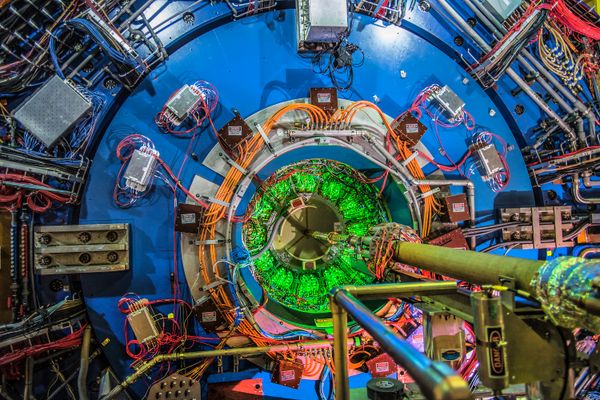
The signal comes from an experiment called the Solenoid Tracker at RHIC (Relativistic Heavy Ion Collider), or STAR. After the gold ions annihilated in collisions and produced new bits of matter, STAR tracked the paths of that debris. One measurement it made compared the particles’ momentum changes with a baseline—in particular, the so-called transverse momentum, the momentum perpendicular to the direction in which the gold ions had been traveling. The STAR data showed a surprising dip in fluctuations of this value—that is, a potential phase transition—at an energy that represents some of the densest states physicists have ever achieved in their studies of nuclear matter. The findings were reported in a paper published recently in Physical Review Letters.
“This measurement is a possible signature that, yes, a phase transition does exist here,” says Rutik Manikandhan of the University of Houston, a member of the STAR team and a co-author of the new analysis. “It hints at the existence of a critical point.”
If scientists discover a critical point—a change in how the phase transition happens at different temperatures and densities—they will better understand how the universe evolved just after it was born. They could also learn what happens to matter at its highest densities, such as within neutron stars, where the mass of an entire star is squeezed into a space about the width of a city.
“We are trying to probe the different phases of matter,” Manikandhan says. “We don’t fully understand what phase of matter is inside neutron stars. We can learn things like ‘What would be the speed of sound inside the core of neutron stars?’” Answering that question would allow astrophysicists to address other mysteries, such as the precise threshold where a neutron star will collapse to form a black hole.
But figuring out what the signal seen by STAR means isn’t easy. “The current data represent an intriguing hint, but they are insufficient to identify the origin of the phenomenon,” says Berndt Mueller, a physicist at Duke University, who wasn’t involved in the experiment. “The problem is that this is only one observable, and it is insufficient to isolate an explanation.”
For instance, instead of a critical point, the dip in momentum fluctuations glimpsed in STAR’s data could simply reflect the fact that as the energy of gold-ion collisions changes, the types of particles being created change, too. At higher energies, more mesons (pairs of quarks and their antimatter counterparts, antiquarks) are present. But at lower energies, more protons and neutrons form. “To make a substantiated claim about the QCD critical endpoint, it is important to rule out such 'trivial' effects, or at least estimate their magnitude with respect to any signals from a critical point,” says Jan Steinheimer, a physicist at the GSI Helmholtz Centre for Heavy Ion Research in Darmstadt, Germany, who studied this alternative explanation.
Researchers plan to analyze more STAR data to further unravel the mystery. RHIC operated for 25 years and shut down earlier in 2026. Yet the machine gathered reams of data that scientists haven’t been able to study yet. “We still have a lot of STAR data left to analyze,” Manikandhan says.