
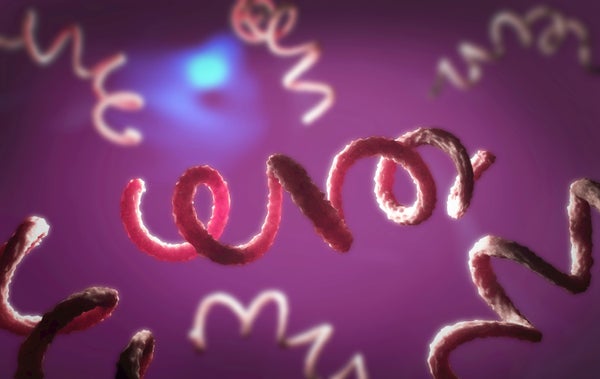
Remains of people who lived on the eastern coast of South America nearly 2,000 years ago have yielded the oldest known evidence for the family of microorganisms that cause syphilis.
The discovery, reported today in Nature, casts further doubt on the already shaky idea that Christopher Columbus’s crew exported syphilis to Europe. More importantly, say scientists, the ancient genomes push back the origins of Treponema pallidum, which causes syphilis and other ‘treponemal’ diseases, by thousands of years.
A destructive family
On supporting science journalism
If you're enjoying this article, consider supporting our award-winning journalism by subscribing. By purchasing a subscription you are helping to ensure the future of impactful stories about the discoveries and ideas shaping our world today.
The most notorious treponemal infection is venereal syphilis, which is generally caused by the subspecies T. pallidum pallidum but can be caused by other ones as well. A second subspecies is most commonly linked to yaws, which cause skin lesions on the hands and feet. And a third causes most cases of an oral infection known as bejel. Left untreated, all three diseases can damage the bones.
The origins of syphilis and the other treponemal diseases remain a mystery. Explosive syphilis outbreaks in Europe starting during the late fifteenth century led to the theory that Columbus’s crew imported the disease from the Americas.
But the lack of clear evidence for syphilis in pre-Columbian remains from the Americas raised questions about this theory. In 2020, researchers reported the discovery of diverse T. pallidum strains in fifteenth century Europe — some of them potentially pre-dating the return of Columbus’s crew. The find suggested that the bacterium had already evolved in Europe for a considerable amount of time before the voyagers’ return.
Before Columbus
To better understand the history of treponemal disease in the Americas, Verena Schuenemann and Kerttu Majander, archaeogeneticists at the University of Zurich in Switzerland who led the 2020 study, and their colleagues looked for signs of treponemal bacteria in bone specimens of human remains buried some 2,000 years ago on Brazil’s southern coast.
The researchers found that the T. pallidum genomes recovered from the bones were most similar to those of the modern subspecies that usually causes bejel — a disease that is not typically found in the Americas today. The ancient genomes were less similar to those of the strains usually associated with yaws or syphilis, which are both found in South America. This implies that the current distribution of T. pallidum subspecies differs from that of the past.
Further analysis of the genomes suggested that known T. pallidum lineages probably began to diversify as long as 14,000 years ago — 10,000 years earlier than previously suggested — and that modern strains evolved in the past 3,000. “It seems they have been accompanying us for a long time, which wasn’t expected,” says Schuenemann.
Searching for Treponema’s origins
The 2,000-year-old T. pallidum genomes are “remarkable”, says Sheila Lukehart, a microbiologist at the University of Washington in Seattle, and mean that the three key subspecies have now all been identified in ancient remains in the Americas.
However, there is growing recognition that the treponemal subspecies can manifest themselves in several ways, Lukehart adds. For instance, bejel- and yaws-linked subspecies have been known to cause venereal syphilis. As a result, she says, “the search for the origin of syphilis is really a search for the origin of the Treponema”.
The discovery of bejel-causing Treponema in Brazil 2,000 years ago doesn’t directly disprove the idea that syphilis came back with Columbus, the researchers say. But the previous evidence for diverse Treponema strains in fifteenth century Europe and the revised evolutionary timescale for T. pallidum makes it even more unlikely. “All this points in the direction that they are not being imported from the Americas,” says Schuenemann.
One possibility is that treponemal diseases emerged even earlier in Eurasia or Africa, and reached the Americas with the first humans to migrate there at least 15,000 years ago.
Another is that the bacteria jumped to humans from an animal host, says Anne Stone, an archaeological geneticist at Arizona State University in Tempe who was not involved in the study. Primates and other animals, including rabbits, can be infected with T. pallidum, she notes. “There may be reservoirs we have to think about.”
This article is reproduced with permission and was first published on January 24, 2024.