
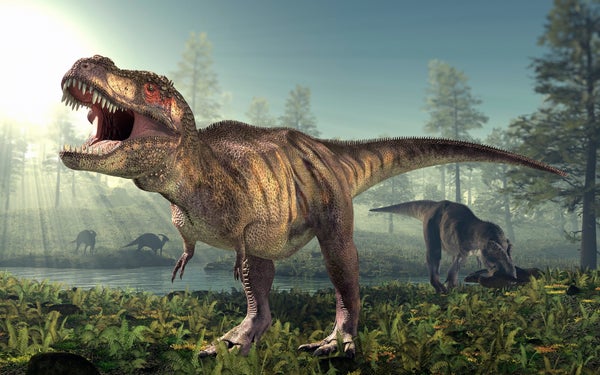
Dinosaur bones are like trees—every year is represented by a new ring, and paleontologists can count those concentric circles to determine a fossil’s age. But new research suggests that in the case of Tyrannosaurus rex, some growth rings have escaped detection until now. That means the king of the tyrant lizards lived longer than experts realized—and never stopped growing larger.
Previous estimates put T. rex’s lifespan at about 30 years, and the dinosaurs were thought to have reached their full size around age 20 to 25. The new research, published today in PeerJ, rewrites that life cycle: bones from 17 specimens indicate that these hulking predators actually stopped growing sometime between 35 and 40 years old and typically reached at least 8.8 tons.
“It took the prince a lot longer to grow into the king,” says Steve Brusatte, a paleontologist at the University of Edinburgh, who was not involved in the new study.
On supporting science journalism
If you're enjoying this article, consider supporting our award-winning journalism by subscribing. By purchasing a subscription you are helping to ensure the future of impactful stories about the discoveries and ideas shaping our world today.
The clues lay hidden in T. rex leg bones all along: while some growth rings are plainly visible, others, it turns out, only reveal themselves in cross-polarized light. Past research overlooked these fainter rings. Holly Woodward, a paleontologist at Oklahoma State University and lead author of the new study, almost did, too.
“I sort of discounted it at first,” she says, “until I started looking at all these specimens and seeing it in a lot of them.”
It’s unclear what the subtler rings mean—maybe a tapping of the growth brakes rather than a complete stop. But the team’s analysis shows that they paint a fuller picture of T. rex’s true age.
Counting growth rings isn’t as simple as counting tree rings. As bones expand, “the earliest growth record gets destroyed,” Woodward says, so only a record of the animal’s later years is left behind. But she and her team had access to specimens of different ages, each capturing some fragment of the species’ lifespan, which enabled them to mathematically nest smaller, younger bones within bigger, older ones. That analysis yielded a more complete reconstruction of the dinosaurs’ growth.
Since the first study investigating T. rex growth in 2004, all the evidence pointed to a creature that surged toward adulthood, much like humans and other modern vertebrates. A more recent study from 2024 describes “explosive growth during the teenage years.” In the absence of more data, many paleontologists had accepted those findings, but some weren’t convinced.
“That seemed pretty quick,” says Thomas Carr, a paleontologist at Carthage College, who was not involved in the PeerJ study. “Extending the age ... makes sense for such a large animal.”
Experts say Woodward and her team’s approach could force paleontologists to reevaluate how fast other dinosaurs and extinct animals grew. And there’s more work to be done to understand the life cycle of T. rex, particularly because the fossil record has precious few juveniles.
Still, Lindsay Zanno, a paleontologist at the North Carolina Museum of Natural Sciences, who was not involved in the new study, describes the findings as a landmark for the field. “We finally have a growth curve for Tyrannosaurus that we can feel confident in,” she says.
Editor’s Note (1/14/26): This article was edited after posting to correct the headline. The text was previously amended on January 14 to correct the description of growth rings in Tyrannosaurus rex bones that are plainly visible.