

For years, paleontologists have been piecing together clues that suggest Tyrannosaurus rex may have been quite unlike modern reptiles—including the possibility that it may have been warm-blooded.
But you can’t stick a T. rex on a treadmill or put a thermometer in its mouth, so scientists must resort to more indirect methods to gauge dinosaurs’ metabolisms and internal temperatures—such as the chemical composition of fossilized teeth. And now, for the first time, researchers say they have pinpointed an exact body temperature for T. rex.
“The enamel chemistry is truly recording the temperature at which it formed, and 66 million years later, we can read it using those measurements on a mass spectrometer,” says Aradhna Tripati, a geoscientist at University of California, Los Angeles, and a co-author of the paper. “It’s the next best thing to sticking a thermometer up a T. rex’s ‘butt,’ which we wouldn’t have wanted to do anyway.”
On supporting science journalism
If you're enjoying this article, consider supporting our award-winning journalism by subscribing. By purchasing a subscription you are helping to ensure the future of impactful stories about the discoveries and ideas shaping our world today.
Using tiny remains of T. rex tooth enamel found in modern-day Montana, scientists measured isotopes within the sample to estimate the dinosaur’s temperature . They found that T. rex likely ran at around 36 degrees Celsius—similar to the internal body temperature of modern-day humans.
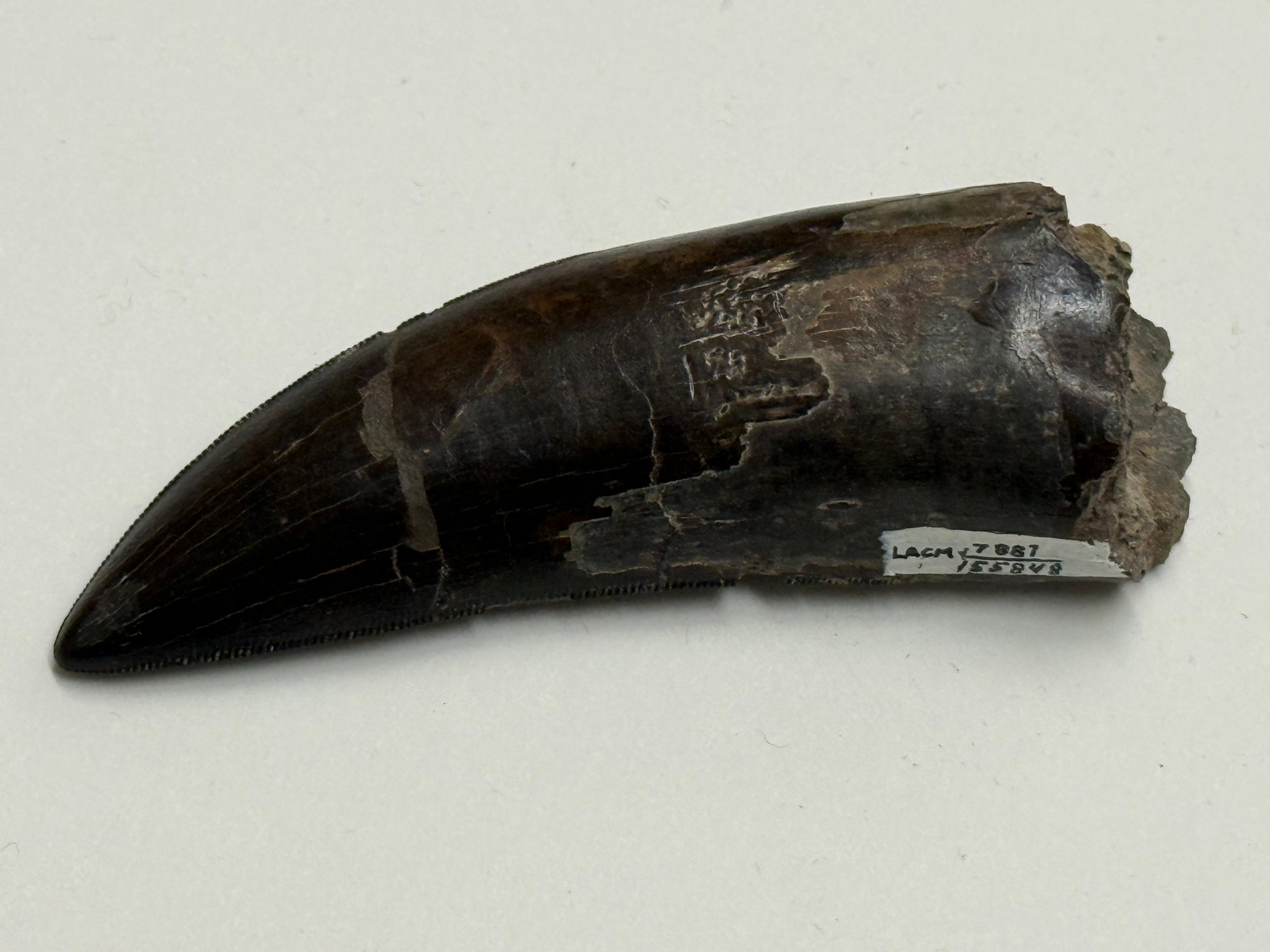
Researchers have estimated dinosaur metabolism and growth rates before, but Tripati says the new study’s method is especially precise at estimating internal temperature because tooth enamel and thermodynamic estimates aren’t as sensitive to confounding factors such as environmental temperatures.
Robert Eagle, a co-author of the study and a geobiologist at University of California, Los Angeles, pioneered this approach to measuring prehistoric body temperatures. He says the findings are a culmination of some 15 years of work. Eagle hopes to use the same technique to suss out the body temperatures of avian dinosaurs and ancient mammalian ancestors next.
“I’m excited that it worked so well because we’ve tried a lot of things with this technique, but this really seemed to be a clear result,” Eagle says. “This gives me optimism that it’s going to be useful looking at other exciting questions.”
The findings add to the growing body of research into how dinosaurs functioned. For example, a 2022 study showed that dinosaurs likely had a range of metabolisms and estimated T. rexes that were on the lower end of endothermy. This new paper, which finds T. rexes’body temperatures to be more similar to those of large mammals than those of smaller, hotter animals such as birds, complements those findings, says Jasmina Wiemann, a paleobiologist at Johns Hopkins University and lead author of the 2022 study.
The new study, published on Wednesday in Science Advances, is “absolutely mind-blowing” and “impressively precise,” Wiemann says. The findings suggest that, based on their temperature, T. rexes likely could have lived anywhere on Earth—even the Arctic, she says.
“It has been really, really exciting to be a young scientist in the field and watching how the collective evidence that we have from different isotope data is converging toward the same picture, suggesting that most nonavian dinosaurs were probably warm-blooded,” Wiemann says.