
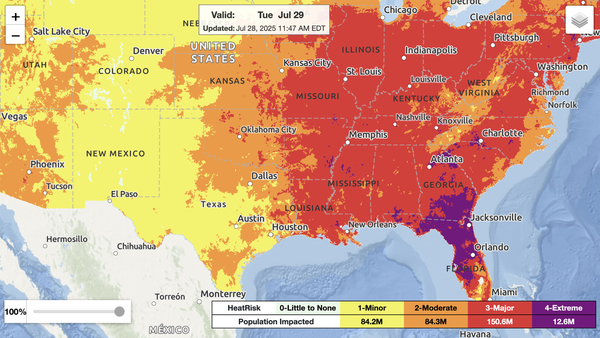
More than 250 million people in the U.S.—nearly three quarters of the population—are experiencing moderate, major or extreme risk of heat effects on July 28, according to the National Oceanic and Atmospheric Administration’s National Weather Service. The warnings come as a heat dome continues to smother the eastern U.S.—and records are starting to fall under the oppressive heat.
Perhaps most surprisingly is that, on July 27, the current heat dome pushed Tampa, Fla., into triple digits Fahrenheit for the first time since monitoring began during the 1890s, according to the Tampa Bay Times. “We’re frequently over 90—for three, four months a year, almost every day it gets above 90,” says Tyler Fleming, a meteorologist at the National Weather Service’s Tampa Bay office. “But getting to 100 takes a lot of heat, so it’s never happened in the recorded history of Tampa.”
Surrounded by water, Tampa—and Florida at large—is usually cursed with enough humidity to keep the overall air temperature, as a thermometer measures it, a bit lower. It takes a lot of energy to heat up water (think about how long it takes to bring water to a boil on the stove), so it takes more energy to heat up humid air to a given temperature than it takes to heat up dry air to the same point, Fleming explains.
On supporting science journalism
If you're enjoying this article, consider supporting our award-winning journalism by subscribing. By purchasing a subscription you are helping to ensure the future of impactful stories about the discoveries and ideas shaping our world today.
READ MORE: Heat Is More Than Just Temperature—Here’s How We Measure It
He says there wasn’t any special factor that caused Tampa’s heat record to occur on Sunday beyond the extremity of the current situation. “We’ve been close many times; we’ve been to 99 several times before,” Fleming says. “It was just a strong heat wave—that was just enough to push us over the edge.”
Tampa is the highest-profile city to see a heat record fall. But the current bout of extreme heat has tied record temperatures in several other cities, including Jacksonville, Fla., and Charlotte, N.C.
Climate change is increasing the odds of breaking heat records everywhere because the global temperature is now higher overall and extreme heat events are becoming more frequent and hotter and lasting longer.
A brutal heat dome has smothered much of the eastern U.S. since last week, with the worst conditions beginning in the Midwest, traveling to the East Coast and then settling over the Southeast. The heat dome is the result of a remarkably large ridge of high pressure that has been stalling over the region. “When that high pressure is overhead, it pushes the air down,” Fleming says. “As the air sinks, it compresses and heats up.”
If you live in an affected area, check out Scientific American’s science-backed tips for staying healthy in extreme heat and for keeping your house cool.
The current heat dome is expected to linger for several more days until the high-pressure system migrates westward, which, Fleming says, should return the region to what he calls “a more typical summer pattern.”
But for now, huge portions of the country remain at risk from the sweltering heat. The NWS HeatRisk map calculates the number of people exposed to different categories of heat risk. On July 28, 16 million people are at extreme risk, which NWS describes as “rare and/or long-duration extreme heat with no overnight relief”; another 135.9 million are at major risk. The map estimates that by July 29, more than 12 million people will remain at extreme risk, and nearly 150 million will be at major risk. And as of July 30, nearly 115 million people are expected to be at major or extreme risk. The widespread high risk will not begin to abate until July 31.