
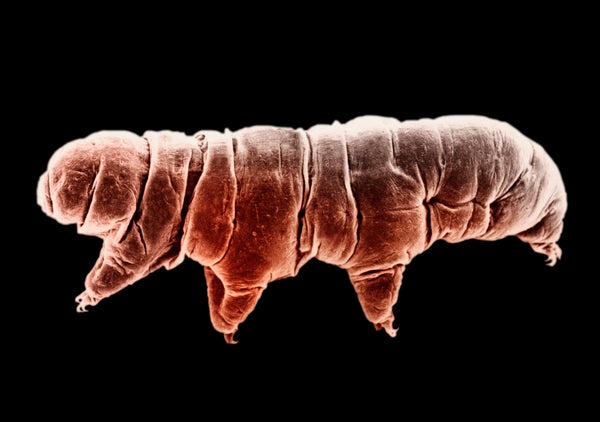
Tardigrades, or water bears, are pudgy, microscopic animals that look like a cross between a caterpillar and a naked mole rat. These aquatic invertebrates are consummate survivors, capable of withstanding a host of extremes, including near total dehydration and the insults of space.
Now, a paper published on September 20 in Nature Communications pinpoints the source of yet another tardigrade superpower: a protective protein that provides resistance to damaging X-rays. And researchers were able to transfer that resistance to human cells.
“Tolerance against X-ray is thought to be a side-product of [the] animal's adaption to severe dehydration,” says lead study author Takekazu Kunieda, a molecular biologist at the University of Tokyo. According to Kunieda, severe dehydration wreaks havoc on the molecules in living things. It can even tear apart DNA, much like X-rays can.
On supporting science journalism
If you're enjoying this article, consider supporting our award-winning journalism by subscribing. By purchasing a subscription you are helping to ensure the future of impactful stories about the discoveries and ideas shaping our world today.
The researchers wanted to know how tardigrades protected themselves against such harsh conditions. So Kunieda and his colleagues began by sequencing the genome of Ramazzottius varieornatus, a species that is particularly stress tolerant. It's easier to study processes within the tardigrade's cells when the animal's genome is inserted into mammalian cells, says Kunieda. So researchers manipulated cultures of human cells to produce pieces of the water bear's inner machinery to determine which parts were actually giving the animals their resistance.
Eventually, Kunieda and his colleagues discovered that a protein known as Dsup prevented the animal's DNA from breaking under the stress of radiation and desiccation. And they also found that the tardigrade-tinged human cells were able to suppress X-ray induced damage by about 40%.
Genomic treasure trove
“Protection and repair of DNA is a fundamental component of all cells and a central aspect in many human diseases, including cancer and ageing,” says Ingemar Jönsson, an evolutionary ecologist who studies tardigrades at Kristianstad University in Sweden.
This makes the new paper’s findings “highly interesting for medicine”, says Jönsson. It opens up the possibility of improving the stress resistance of human cells, which could one day benefit people undergoing radiation therapies.
Kunieda adds that these findings may one day protect workers from radiation in nuclear facilities or possibly help us to grow crops in extreme environments, such as the ones found on Mars.
Bob Goldstein, a biologist at the University of North Carolina at Chapel Hill who helped to sequence the genome of another tardigrade species, says the research is exciting and clever. He also thinks that the study’s authors are correct in predicting that this is probably just the first of many such discoveries.
“The tardigrade is resistant to a lot of different kinds of extremes,” says Goldstein. And this means that the animals must have many different ways of protecting themselves.
“We are really just at the beginning of exploring the genetic treasure that the tardigrade genome represents,” says Jönsson.
This article is reproduced with permission and was first published on September 20, 2016.