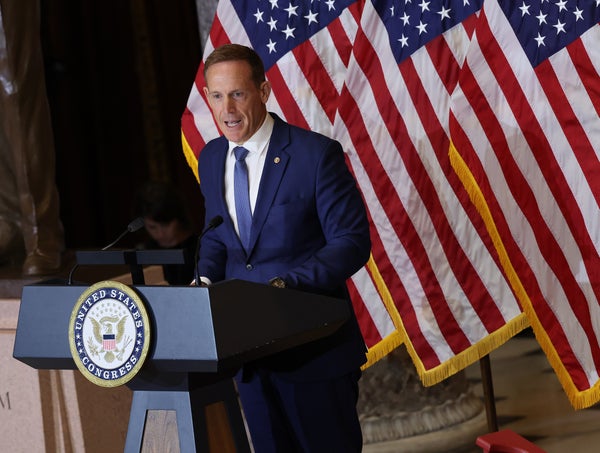
Ted Budd is a U.S. senator who has been representing North Carolina since 2023, and he is a member of the Senate Committee on Commerce, Science, and Transportation. A Republican, Budd previously served in the U.S. House of Representatives from 2017 to 2023, and he has a background in business and farming.
[This interview was edited for length and clarity.]
If we have learned anything from our nation’s 250-year history, it is that American scientific innovation drives technological advancement and economic growth at home and around the globe. While our academic institutions and national labs continue to be the envy of the world, we are being displaced by China in the research of critical and emerging technologies. American science must regain and retain leadership in the research and development of artificial intelligence, quantum computing, biotechnology, and energy and materials to ensure the next 250 years benefit Americans economically and support our national security. So I’d say American scientific efforts are strong, but we’re in a period of relative and competitive risk.
On supporting science journalism
If you're enjoying this article, consider supporting our award-winning journalism by subscribing. By purchasing a subscription you are helping to ensure the future of impactful stories about the discoveries and ideas shaping our world today.
What needs to change in American science?
AI is quickly becoming the most rapidly adopted general-purpose technology in history, and it relies on four main inputs: talent, compute, data and energy. We already have the potential to continue dominating in computation, data access and analysis. But we need to invest in energy and talent, or we risk falling behind.
First, when it comes to energy, the U.S. is being rapidly outpaced by China. Not only does China have a population three to four times larger than ours, but it also has 3.5 terawatts of power generation capacity, more than double that of the U.S. If we are going to compete, we need more energy to store and access data on servers, as well as to train models effectively.
Second, investing in an AI-ready workforce is nonnegotiable and a priority of mine in the U.S. Senate. The American workforce is our greatest strength, and to avoid massive job displacement as technology advances, we need to equip our workforce with the resources they need to reskill quickly as the job market transitions. My PELL [Promoting Employment and Lifelong Learning] Act, which was signed into law last year, focuses on retooling by modernizing Pell Grant eligibility to help Americans gain in-demand skills in as little as eight weeks.
What gives you optimism right now?
As a small business owner, I’ve seen firsthand how AI can empower, not shrink, a workforce. I remember the first time I shared a monthly financial statement generated with an AI tool with my team. You could see the concern on their faces, but it opened the door to an important conversation about what this technology really means for working people.
AI is not a substitute for human talent. It allows us to do more and do better by freeing the workforce from repetitive tasks so they can focus on higher-value, more impactful work. That’s the same mindset a growing number of CEOs are adopting, as 55 percent say AI is driving optimism about company growth and plans to increase hiring. If we approach this technology thoughtfully, AI won’t replace workers; it will empower them and strengthen our economy.
What’s your best advice for an early-career scientist?
Ask yourself, “What has the power to shape the future by solving real-world problems?” While we need to push the limits of scientific exploration, we must also ensure discoveries continue to benefit humanity. Sometimes the most impactful innovations come from solving seemingly small problems in daily life. And you never know where that knowledge or technological advancement will go next.
How has your work related to science changed in the past few years?
My work in science and technology has shifted to focus more on maintaining America’s competitive edge for years to come, whether by integrating new technologies such as quantum computing or by prioritizing the pathway to an advanced manufacturing renaissance. The policies I am introducing and supporting in Congress are focused on keeping the U.S. ahead of competitors and potential adversaries.
Take AI, for example: our systems are only as good as the data we feed into our models. The U.S. federal government maintains the world’s largest and most sophisticated data assets across every discipline, but we have yet to leverage that potential in American AI models. That’s why I introduced the bipartisan Artificial Intelligence Ready Data Act to unlock the resources we already have at our fingertips to advance America’s competitive edge and global leadership in AI.
Is the U.S. still the undisputed destination for the world's brightest minds?
Absolutely, one only needs to visit the Research Triangle in my home state of North Carolina or stop by Silicon Valley in California to see the draw of America. But we can’t take that for granted and must continue to invest in talent at home and attract talent from abroad. That requires continuous effort and collaboration with industry, policymakers and academia to be successful.
Is American science funded in the right ways? If not, what needs to change?
The funding of American science is at a crossroads—one that has caused significant angst over the past year as we have begun a much needed reset.
We built our scientific dominance on a simple but powerful compact: government funds basic research that the private sector won’t, and the private sector turns those discoveries into products, jobs and economic growth. That compact broke down—not because we invested too much in science but because we lost discipline in investing wisely. Instead we wasted taxpayer funds on politically charged programs with little to no likelihood of providing meaningful benefits to the American people. Federal science agencies grew bloated to serve constituencies rather than seek knowledge or truth.
The fix isn’t to gut federal science funding but to restore accountability and strategic clarity. I think we’re now headed in that direction.