
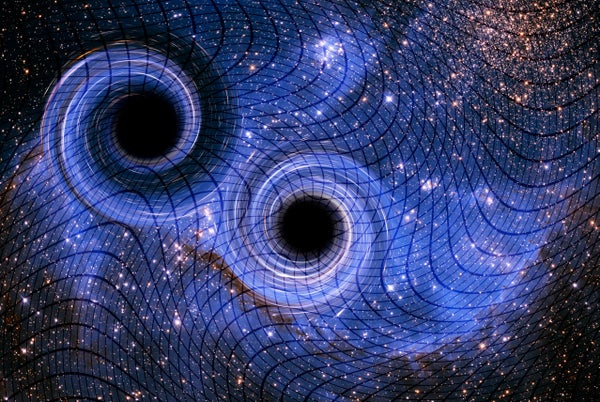
Just more than a decade ago, the Laser Interferometer Gravitational-Wave Observatory (LIGO) picked up the signal of something entirely new: a ripple in the fabric of spacetime. About 1.3 billion light-years away, two massive black holes had merged, and the resulting shockwave—a gravitational wave—was strong enough for LIGO to detect the moment it washed over Earth.
Since then gravitational-wave researchers have focused on fine-tuning their instruments to detect more of these fleeting ripples. Each confirmed or high-quality candidate event is added to a running tally in a catalog maintained by the LIGO-Virgo-KAGRA (LVK) Collaboration, a network of four gravitational-wave detectors: the two LIGO stations in the U.S., the Virgo station in Italy and the Kamioka Gravitational Wave Detector (KAGRA) in Japan. The newest entries on the collaboration’s list—a record-breaking 161 events spotted between April 2024 and January 2025—have researchers excited for a new era of discovery, an “age of gravitational astronomy.”
“The extraordinary sensitivity of our detectors now allows us to capture three or four gravitational wave signals every week,” said Ed Porter, a researcher at the AstroParticle and Cosmology Laboratory, overseen by the French National Center for Scientific Research (CNRS) and Paris City University, in a statement. “This ever-growing wealth of data, which an entire community of scientists and astronomers is working to analyze and study, has taken us from the era of initial discoveries into that of precision gravitational astronomy.”
On supporting science journalism
If you're enjoying this article, consider supporting our award-winning journalism by subscribing. By purchasing a subscription you are helping to ensure the future of impactful stories about the discoveries and ideas shaping our world today.
These recent weekly signals form about 75 percent of the total number of confirmed gravitational-wave events observed by the LVK network; the total is now up to 390. Having more observations of these unusual cosmic events gives researchers the ability to study phenomena and locales of the universe that are too faint or far away to detect through other methods, as well as to better understand the nature and evolution of black holes and a diverse assortment of other fundamental questions in astrophysics.
Among the exciting findings from the latest batch of gravitational-wave detections are GW240615, for which scientists were able to triangulate the exact location of the event’s source; GW250114, which offered the clearest signal ever recorded, with a signal-to-noise ratio of 76.9; and GW241011 and GW241110, which, scientists say, collectively support the existence of “second-generation black holes” that form solely from the mergers of smaller black holes.
“It is another hint that the Universe may still be hiding important pieces of the story of how black holes are born, evolve and merge,” said Mario Spera, a Virgo Collaboration researcher at the International School for Advanced Studies (SISSA) in Italy, in the same statement. “And this picture will become richer, and more surprising, with every new gravitational-wave catalog by LVK.”
The 161 new entries provide enough data to keep scientists busy for years, but the LVK Collaboration says there is a lot more to come—especially as researchers continue optimizing the detectors to make them even more sensitive to spacetime ripples.