
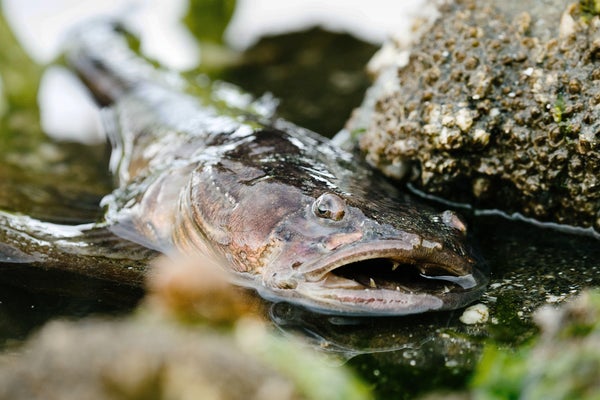
The world of larval plainfin midshipman fish (Porichthys notatus) may look alien, but it could be as close as the cobbles beneath your feet, if you walk a rocky stretch of shore on much of the North American West Coast. Adults of this species swim each spring from ocean depths—up to 366 meters (1,200 feet) beneath the surface—to the intertidal zone to spawn in the shallows, where males excavate nests beneath large rocks. There, they set about trying to attract females and, if successful, rear young.
Perhaps because this species of toadfish is “grotesque in appearance,” as one 1948 description put it, with muddy coloring and vampiric fangs, most males rely on their voices to summon potential mates. They regularly croon at night, rapidly contracting muscles along their swimbladders to produce a monotonous tone resembling the low notes of a trombone. On occasion, they will make this call for more than an hour at a stretch. Multiple males singing at once creates a drone that’s audible through the bottom of a boat, and reportedly loud enough to disrupt conversation or wake someone who is fast asleep. And no wonder, since at least one observer compared the sound to “a huge hive of bees or a group of motorboats.”
Female midshipmen find it irresistible, however. Those drawn to a particular male’s croon will collectively lay hundreds of eggs on the stone ceiling of his watery nest, where he can fertilize them. Unless someone else does, that is. Smaller “sneaker” males often lurk nearby and sometimes inseminate eggs before the guarding male can fend them off. Sneakers don’t sing or build nests, but what they lack in vocal skills and architectural acumen they make up for in cunning—and in testes, which can be as much as seven times larger relative to their body size than those of the crooning “guarder” males.
On supporting science journalism
If you're enjoying this article, consider supporting our award-winning journalism by subscribing. By purchasing a subscription you are helping to ensure the future of impactful stories about the discoveries and ideas shaping our world today.
When this courtship chaos is over, so too are the parts played by the sneaker males and the brood’s moms. Thus abandoned, the singing male braves up to four months of high and low tides to tend those eggs, even though many of them may not hold his offspring. And yet, plainfin midshipman—so named because the pattern of bioluminescent photophores on their bodies resemble the buttons on a naval uniform—are stalwart attendants. They rely on special physiological adaptations to stay put through wild temperature swings and occasional exposure to air. All the while, they ward away predators and use their fins to clean debris from and oxygenate the developing larvae.
This is hungry, even starving, work. With so many hundreds of eggs and babies available in each nest, researchers have shown that some 69 percent of guarding males snack on them, even when other food is available. Recent research suggests that this practice is largely aimed at making way for newer additions to the brood in which paternity may be more certain, since it generally occurs at the start of the egg-guarding season, rather than the end. Fortunately, there are enough babies in each brood to ensure that most survive this dubious aspect of their guardians’ tending. They eventually outgrow the golden yolks anchoring them to their nest rocks, thrashing free and returning to the deep, where they will begin this bizarre and fascinating cycle all over again.
This article was first published on bioGraphic © 2024 California Academy of Sciences.