
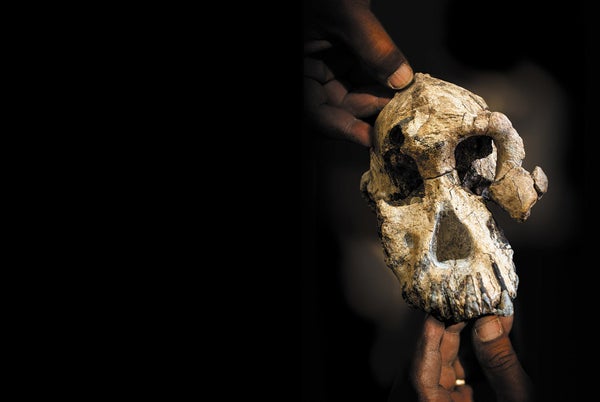
Nearly 25 years after scientists described the first fossil traces of Australopithecus anamensis, this unsung human ancestor is finally having its moment. Researchers working in Ethiopia have found a nearly complete cranium of this long-vanished member of the hominin group, which includes Homo sapiens and its close extinct relatives. The fossil, dated to 3.8 million years ago, reveals the never before seen face of A. anamensis, a species previously known mainly from jaws, teeth and a smattering of bones from below the head. Traits evident in the specimen hint that our family tree may need revising.
By some accounts, A. anamensis is the oldest unequivocal hominin, with some fossils dating from as far back as 4.2 million years ago. For years it has occupied a key position in the family tree as the lineal ancestor of Australopithecus afarensis, which is widely viewed as the ancestor of our own genus, Homo. Based on the ages and characteristics of the available fossils, paleoanthropologists thought A. anamensis gave rise to A. afarensis through an evolutionary process termed anagenesis, in which one species transforms into another. The new fossil throws a wrench into the works of that theory.
Yohannes Haile-Selassie of the Cleveland Museum of Natural History and his colleagues recovered the cranium from an area in northeastern Ethiopia’s Afar region known as Woranso-Mille. Features of its teeth and jaws link it to the previously known fragmentary remains of A. anamensis. The fossil shows a creature with a projecting face, large canine teeth, flaring cheekbones, a crest atop its head that anchored strong jaw muscles, and a long, narrow braincase that held a brain the size of a chimpanzee’s. The discovery team suspects the cranium belonged to an adult male A. anamensis.
On supporting science journalism
If you're enjoying this article, consider supporting our award-winning journalism by subscribing. By purchasing a subscription you are helping to ensure the future of impactful stories about the discoveries and ideas shaping our world today.
Here is how it could upend the conventional wisdom: on the basis of the more complete A. anamensis anatomy seen in the newly discovered cranium, Haile-Selassie and his colleagues argue that an enigmatic 3.9-million-year-old forehead bone from the site of Belohdelie, also located in Ethiopia’s Afar region, belongs to A. afarensis. If this supposition is right, A. anamensis, which is known from fossils spanning the time between 4.2 million and 3.8 million years ago, and A. afarensis, which apparently lived from 3.9 million to 3.0 million years ago, actually overlapped for at least 100,000 years in the Afar. And that overlap would imply that A. anamensis could not have evolved into A. afarensis by means of anagenesis. Instead A. afarensis split off from A. anamensis, which continued to exist for a time alongside its daughter species. This branching mode of evolution, known as cladogenesis, can occur when populations of a species become isolated from one another and are thus able to evolve in different directions.
But the case for cladogenesis over anagenesis hinges entirely on that 3.9-million-year-old forehead bone from Belohdelie belonging to A. afarensis—no other A. afarensis remains recovered thus far are that old. Problematically, with only one A. anamensis forehead bone to compare it with—the one in the new fossil—one cannot exclude the possibility that other A. anamensis individuals might have had foreheads that looked like the Belohdelie one. Only discovery of more fossil faces can resolve that unknown.