
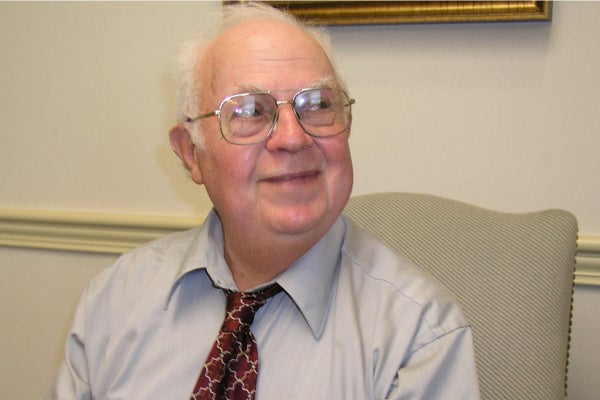
Donald Triplett, who was the first person to be diagnosed with autism, died last week in his hometown of Forest, Mississippi, at age 89. The cause of death was cancer, according to The New York Times.
Triplett gained media attention for his autism later in life, and he became the face of the effort to research the lives of “older adults” with autism, says Joseph Piven, professor of psychiatry and pediatrics at the University of North Carolina at Chapel Hill. Triplett was embraced by his local community, Piven says, which likely “made a huge difference in his life and should encourage the field towards exploring all aspects of autism in older age to maximize quality of life for others who follow him.”
He was born Donald Gray Triplett on 8 September 1933 to Mary and Beamon Triplett, a wealthy couple. As a child, Donald was, in his father’s words, “happiest when he was alone … drawing into a shell and living within himself … oblivious to everything around him.” He was sent to a state-run children’s facility in Mississippi in 1937.
On supporting science journalism
If you're enjoying this article, consider supporting our award-winning journalism by subscribing. By purchasing a subscription you are helping to ensure the future of impactful stories about the discoveries and ideas shaping our world today.
His parents, regretting this decision, removed him from the facility a year later against doctor’s recommendations and took him to meet psychiatrist Leo Kanner at Johns Hopkins University in Baltimore, Maryland. Beamon Triplett had a reputation for detail and intensity — he had been through two mental breakdowns — and he mailed Kanner 33 pages of notes on his boy’s mannerisms and life history, including that Donald could “hum and sing many tunes accurately” at 1 year old and would sometimes have emotional breakdowns if his activities were interfered with, according to Kanner’s seminal paper, published in 1943, “Autistic disturbances of affective contact.” Triplett was one of the 11 children Kanner described in that paper, in which he was referred to as “Donald T.” under the heading “Case 1.”
At age 9, Triplett went to live on a family farm, some 10 miles away from his childhood home. The couple who owned the farm had no children of their own, and they directed Triplett’s energies toward well-digging and counting rows of corn as he plowed.
Triplett spent four years there and went on to graduate from high school and college, studying French and math at Millsaps College in Mississippi, where he also sang in an a capella choir and joined a fraternity. He returned to live with his parents after graduation. As an adult, he was an avid traveler and worked as a bookkeeper at a local bank.
Even though both of his parents died in the 1980s, Triplett continued to live in the house where they had raised him, in relative obscurity until two journalists went looking for “Case 1,” using old medical records to connect “Donald T.” to a person still living in Mississippi.
The resulting 2010 article in The Atlantic depicted Triplett’s life as a golf-loving retiree. His life story was featured by the same journalists in the 2016 book “In a Different Key: The Story of Autism,” which was a finalist for the Pulitzer Prize and spawned a documentary that aired on PBS in 2022.
This story was originally published on Spectrum.