
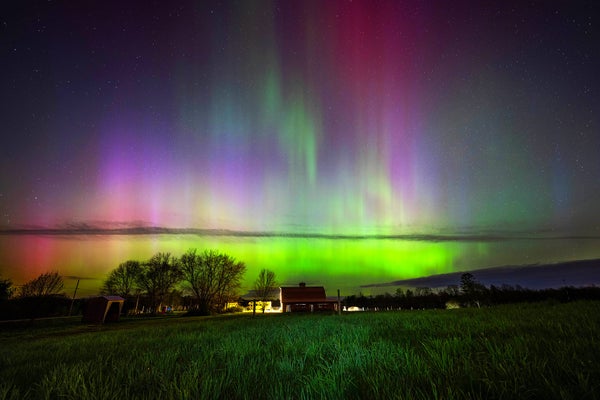
This month's ramped-up auroras may have been even more remarkable than we thought.
The auroral displays that wowed observers around the world two weekends ago, including folks as far south as Florida in the U.S. and Ladakh in northern India, may have been among the strongest such light shows since record-keeping began.
"With reports of auroras visible to as low as 26 degrees magnetic latitude, this recent storm may compete with some of the lowest-latitude aurora sightings on record over the past five centuries, though scientists are still assessing this ranking," NASA officials said in a statement.
On supporting science journalism
If you're enjoying this article, consider supporting our award-winning journalism by subscribing. By purchasing a subscription you are helping to ensure the future of impactful stories about the discoveries and ideas shaping our world today.
"It's a little hard to gauge storms over time because our technology is always changing," Delores Knipp, a research professor at the University of Colorado Boulder who focuses on space weather, added in the same statement. "Aurora visibility is not the perfect measure, but it allows us to compare over centuries."
The northern and southern lights are usually a spectacle only in high-latitude areas such as the Arctic and northern Canada. But the vivid colors migrated toward the equator on May 10 because of a rare G5 geomagnetic storm unleashed by our hyperactive sun a few days prior, the strongest to hit our planet since Halloween of 2003.
Between May 3 and May 9, NASA's Solar Dynamics Observatory cataloged 82 "notable" solar flares spawning from two active regions on the sun (3663 and 3664). These clusters of sunspots grew so complex that they erupted repeatedly during the week. Starting on May 7, at least seven coronal mass ejections, or CMES, charged toward Earth and began storming our planet on May 10, which was when the strongest auroras were seen.
"The CMEs all arrived largely at once, and the conditions were just right to create a really historic storm," Elizabeth MacDonald, a space physicist at NASA's Goddard Space Flight Center in Maryland, said in the statement.
This storm was so intense that the U.S. National Oceanic and Atmospheric Administration, which forecasts solar storms and their impact on our planet, issued a storm warning for the first time in nearly two decades. The warning prompted NASA to preemptively put at least one of its satellites, ICESat-2, into safe mode. Certain instruments onboard other missions were also powered down, the space agency noted in the statement.
To better understand the full extent of the event, scientists are also studying reports submitted by citizen scientists to the NASA-funded effort known as Aurorasaurus, which tracks auroras around the world. Aurora-related tweets and reports are aggregated into a map and verified with the help of citizen scientists, according to the website. Each verified report then becomes a data point for scientists to study and potentially incorporate into space weather models.
"We'll be studying this event for years," said Teresa Nieves-Chinchilla, acting director of NASA's Moon to Mars Space Weather Analysis Office. "It will help us test the limits of our models and understanding of solar storms."
The cluster of sunspots that sparked the historic dazzling display of lights has rotated out of our view, thanks to the sun's spin. However, scientists say it is now coming into view of Mars, which has already begun witnessing the impacts of AR3664’s strongest flare yet, which was fired off last Tuesday (May 14), scientists say.
"We're already starting to capture some data at Mars, so this story only continues," said Jamie Favors, director for the NASA Space Weather Program in Washington.
Copyright 2024 Space.com, a Future company. All rights reserved. This material may not be published, broadcast, rewritten or redistributed.