

The following essay is reprinted with permission from The Conversation, an online publication covering the latest research.
Speed alone may be the factor that draws many sports fans to the bobsled, luge and skeleton events at this year’s Beijing Winter Olympics. But beneath the thrilling descents of the winding, ice-covered track, a myriad of concepts from physics are at play. It is how the athletes react to the physics that ultimately determines the fastest runs from the rest of the pack.
On supporting science journalism
If you're enjoying this article, consider supporting our award-winning journalism by subscribing. By purchasing a subscription you are helping to ensure the future of impactful stories about the discoveries and ideas shaping our world today.
I study the physics of sports. Much of the excitement of a luge run is easy to miss – the athletes’ movements are often too small to notice as they fly by looking like nothing more than a blur on your television. It would be easy to assume that the competitors are simply falling or sliding down a track at the whim of gravity. But that thought merely scratches the surface of all the subtle physics that go into a gold-medal-winning performance.
Gravity and energy
Gravity is what powers the sleds down the ice-covered tracks in bobsled, luge and skeleton events. The big-picture physics is simple – start at some height and then fall to a lower height, letting gravity accelerate athletes to speeds approaching 90 mph (145 kph).
This year’s races are taking place at the Yanqing National Sliding Center. The track is roughly a mile long (1.6 km), drops 397 feet of elevation (121 meters) – with the steepest section being an incredible 18% grade – and comprises 16 curves.
Riders in the sledding events reach their fast speeds because of the conversion of gravitational potential energy into kinetic energy. Gravitational potential energy represents stored energy and increases as an object is raised farther from Earth’s surface. The potential energy is converted to another form of energy once the object starts falling. Kinetic energy is the energy of motion. The reason a flying baseball will shatter the glass if it hits a window is that the ball transfers its kinetic energy to the glass. Both gravitational potential energy and kinetic energy increase as weight increases, meaning there is more energy in a four-person bobsled team than there is in a one-person luge or skeleton for a given speed.
Racers are dealing with a lot of kinetic energy and strong forces. When athletes enter a turn at 80 mph (129 kph) they experience accelerations that can reach five times that of normal gravitational acceleration. Though bobsled, luge and skeleton may look easy, in reality they are anything but.
Aerodynamics
Most tracks are around a mile long (1.6 km), and the athletes cover that distance in just under a minute. Final times are calculated by adding four runs together. The difference between the gold medal and silver medal in the men’s singles luge at the 2018 Winter Olympics was just 0.026 seconds. Even tiny mistakes made by the best athletes in the world can cost a medal.
All the athletes start at the same height and go down the same track. So the difference between gold and a disappointing result comes not from gravity and potential energy, but from a fast start, being as aerodynamic as possible and taking the shortest path down the track.
While gravity pulls the athletes and their sleds downhill, they are constantly colliding with air particles that create a force called air drag, which pushes back on the athletes and sleds in a direction opposite to their velocity. The more aerodynamic an athlete or team is, the greater the speed.
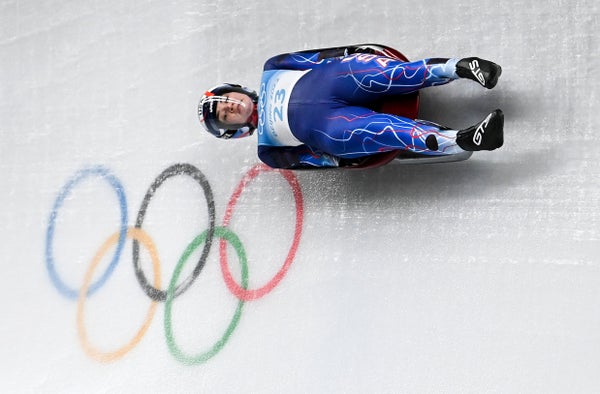
To minimize drag from the air, luge riders – who are face up – lie as flat as possible. Downward-facing skeleton riders do the same. Whether in a team of two or four, bobsled riders stay tucked tightly inside the sled to reduce the area available for air to smash into. Any body positioning mistakes can make athletes less aerodynamic and lead to tiny increases in time that can cost them a medal. And these mistakes are tough to correct at the high accelerations and forces of a run.
The shortest way down
Besides being as aerodynamic as possible, the other major difference between a fast and a slow run is the path riders take. If they minimize the total length taken by their sleds and avoid zigzagging across the track, riders will cover less distance. In addition to simply not having to go as far to cross the finish line, shortening the path means facing less drag from air and losing less speed from friction with the track.
Fans often miss the subtleties involved in turning and steering. The sleds for all the events sit on steel blades called runners. Bobsleds have two sets of runners that make contact with the ice. The front rider pulls on rings attached to pulleys that turn the front runners. Runners on luge sleds have curved bows at the front where riders place their calves. By moving their head and shoulders or flexing their calves, athletes can turn the luge. Skeleton riders lack these controls and must flex the sled itself using their shoulders and knee to initiate a turn. Even a tiny head movement can cause the skeleton to move off the optimal path.
All of these subtle movements are hard to see on television, but the consequences can be large – oversteering may lead to collisions with the track wall or even crashes. Improper steering may lead to bad turns that cost riders time.
Though it may appear that the riders simply slide down the icy track at great speeds after they get going, there is a lot more going on. Viewers will have to pay close attention to the athletes on those fast-moving sleds to detect the interesting facets of physics in action.
This article was originally published on The Conversation. Read the original article.