
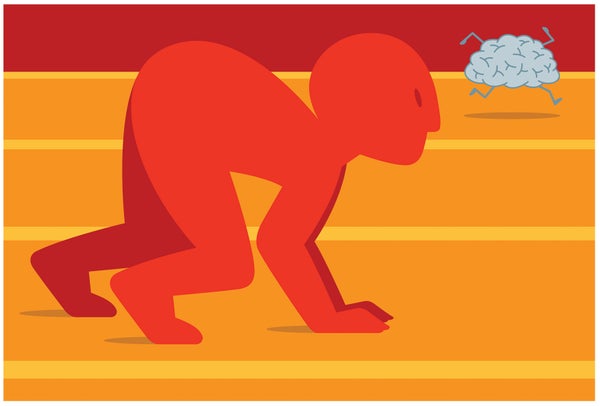
People often feel that their inner thoughts and emotions are much richer than what they are capable of expressing in real time. Entrepreneur Elon Musk is so bothered by what he calls this “bandwidth problem,” in fact, that one of his long-term goals is to create an interface that lets the human brain communicate directly with a computer, unencumbered by the slow speed of speaking or writing.
If Musk succeeded, he would probably be disappointed. According to research published in January 2025 in Neuron, human beings remember, make decisions and imagine things at a fixed, excruciatingly slow speed of about 10 bits per second. In contrast, human sensory systems gather data at about one billion bits per second.
This biological paradox, highlighted in the study, probably contributes to the false feeling that our mind can engage in seemingly infinite thoughts simultaneously—a phenomenon the researchers deem “the Musk illusion.” Study co-author Markus Meister, a neuroscientist at the California Institute of Technology, says that “the human brain is much less impressive than we might think. It’s incredibly slow when it comes to making decisions, and it’s ridiculously slower than any of the devices we interact with.”
On supporting science journalism
If you're enjoying this article, consider supporting our award-winning journalism by subscribing. By purchasing a subscription you are helping to ensure the future of impactful stories about the discoveries and ideas shaping our world today.
Meister and his co-author, Jieyu Zheng, a doctoral candidate in neurobiology at Caltech, also highlight in their paper that our brain can do only one thing—slowly—at a time. Even if Musk managed to hook his brain up to a computer, Meister says, he still wouldn’t be able to communicate with it any faster than he could if he used a telephone.
This research builds on decades of psychology studies showing that humans selectively perceive just a small portion of information from the sensory experience. “We can only pay attention to so much, and that’s what becomes our conscious experience and enters memory,” Meister says. What has been missing from past research, he continues, is “any sense of numbers.” He and Zheng have endeavored to fill that quantitative gap.
Meister and Zheng collated data from research across different fields, including psychology, neuroscience, technology and human performance. They used this information—from the processing speed of single neurons to the cognitive prowess of memory champions—to run many of their own calculations so they could make comparisons between studies.
From research spanning nearly a century, they found that human cognition has repeatedly been measured as functioning at between about five and 20 bits per second, with a ballpark average of around 10 bits per second. “This was a very surprising number,” Zheng says. Based on this finding, she adds, she and Meister also calculated that the total amount of information a person can learn across their lifetime could comfortably fit on a small thumb drive.
Human sensory systems such as sight, smell and sound, in contrast, operate much faster, the authors found—at about 100,000,000 times the rate of cognition. “When you put these numbers together, you realize there’s this huge gap,” Meister says. “From that paradox comes interesting new opportunities for science to organize research differently.”
The rich information relayed by our senses also contributes to a false notion that we register the massive amount of detail and contrast around us. But that’s “demonstrably not true,” Meister says. When people are asked to describe what they see outside the center of their gaze, they “barely make out anything,” he adds. Because our eyes are capable of focusing on any detail, he continues, “our mind gives us the illusion that these things are present simultaneously all the time,” even though in actuality we must focus on specific visual features to register them. A similar phenomenon occurs with mental ability. “In principle, we could be having lots of different thoughts and direct our cognition in lots of different ways,” Meister says. “But in practice, we can have only one thought at a time.”
Another problem that contributes to an overinflated sense of our own mind, he adds, is that we have no marker of comparison: “There’s no way to step outside ourselves to recognize that this is really not much to brag about.”
The findings raise questions in many domains, from evolution and technology to cross-species comparisons, the authors write. One of the questions Meister and Zheng are most curious about, though, is why the prefrontal cortex—thought to be the seat of personality and behavioral control—houses billions of neurons yet has a fixed decision-making capability that processes information at just 10 bits per second. The researchers suspect the answer might have something to do with the brain’s need to frequently switch tasks and integrate information across different circuits. But more complex behavioral studies will be needed to test that hypothesis.
Another important unanswered question, Meister says, is why the human brain can do only one thing at a time. “If we could have 1,000 thoughts in parallel, each at 10 bits per second, the discrepancy wouldn’t be as big as it is,” he says. Why humans are incapable of such mental multitasking is “a deep mystery that almost nothing is known about.”
Anthony Zador, a neuroscientist at Cold Spring Harbor Laboratory in New York State, who was not involved in the study but is mentioned in the paper’s acknowledgments, says this “wonderful and thought-provoking” work presents what seems to be a newly recognized fundamental truth about the brain’s upper limit of “roughly the pace of casual typing or conversation.”
“Nature, it seems, has built a speed limit into our conscious thoughts, and no amount of neural engineering may be able to bypass it,” Zador says. “Why? We really don’t know, but it’s likely the result of our evolutionary history.”
Nicole Rust, a neuroscientist at the University of Pennsylvania, who also was not involved in the research, says the study could reshape how neuroscientists approach some of their work.
“Why can our peripheral nervous system process thousands of items in parallel, but we can do only one thing at a time?” Rust says. “Any theory of the brain that seeks to account for all the fascinating things we can do, like planning and problem-solving, will have to account for this paradox.”