
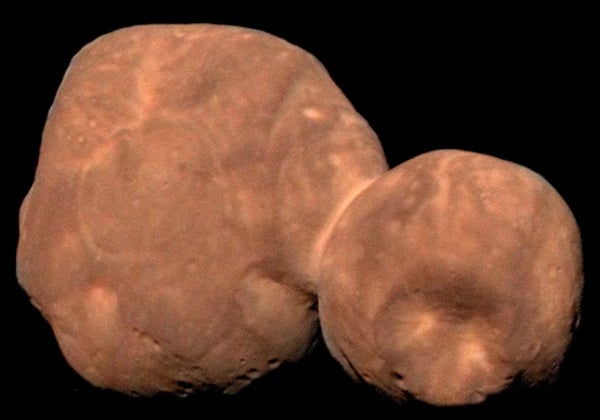
Out in the Kuiper Belt, the massive doughnut of debris beyond Neptune, about one in 10 kilometer-scale objects have surprised scientists with their unexpected shape. Rather than resembling a ball, each of these remnants from the solar system’s early history is composed of two different-sized lobes, like a peanut or a lazily assembled snowman.
Astronomers got their clearest view yet of the phenomenon when NASA’s New Horizons mission flew by the two-lobed Kuiper Belt object Arrokoth in 2019. But they’ve steadily found additional examples of these strangely shaped “planetesimals”—the technical term for the icy, rocky building blocks that assembled into our solar system’s planets billions of years ago. Solving the mystery of these snowmanlike objects, researchers hope, could unlock a deeper understanding of how exactly Earth and other worlds first came to be.
Now one team has an explanation, helping place another piece in the ongoing puzzle of planet formation.
On supporting science journalism
If you're enjoying this article, consider supporting our award-winning journalism by subscribing. By purchasing a subscription you are helping to ensure the future of impactful stories about the discoveries and ideas shaping our world today.
“When we first saw the results of our simulations, we were very excited,” says Jackson Barnes, a graduate student at Michigan State University. Barnes is lead author of the new paper, which was published today in the Monthly Notices of the Royal Astronomical Society. “It was even more exciting to see that it was not unique, and we had in fact created many of these bilobed objects with different lobe shapes and sizes.”
“It is marvelous work,” says William McKinnon, a planetary scientist at Washington University in St. Louis who was not involved with the new work. “What the authors have done is demonstrate that the most direct pathway is indeed quite physically plausible.”
Previous studies assumed that these peanuts—called “contact binaries”—were originally two separate spheres that were locked in a spiraling dance until a glancing impact fused them at the hip. But this cosmic mating ritual would have been too slow to have already ended for every contact binary we see. The new study instead depicts them forming in unison.
“Formation of contact binaries from two separate bodies does not work too well,” says David Nesvorný, an astronomer at the Southwest Research Institute in Boulder, Colo., who was not involved in the study. “So we suspected that contact binaries formed during gravitational collapse, but this is the first work that simulates their formation in detail.”
Some 4.6 billion years ago, a giant cloud of gas and dust collapsed under its own gravity to ignite our sun. The leftovers coalesced into a dusty disk swirling around the infant star. Then, astronomers believe, denser swarms of pebbles within that disk also collapsed much like the original cloud, forming kilometer-scale planetesimals.
Think of the Kuiper Belt as an outer reach of this protoplanetary disk that was frozen in time at that moment. Out there, the planetesimals are too sparse and move too slowly to find one another often, and therefore most have never agglomerated into planets.
So why were so many of them peanut-shaped? Either the pebble clouds sometimes collapsed into two separate, co-orbiting bodies that spiraled closer together over time or this binary formed at once, with the rapid spinning and stickiness of the icy pebbles somehow producing the strange shape. To astronomers, the former couldn’t explain the shape’s ubiquity, but the latter was difficult to mathematically model.
The new study rectifies this with high-powered computing, breaking a virtual dust cloud into tiny chunks and simulating how they all interact during a gravitational collapse. About 4 percent of the simulations result in contact binaries. That’s less than the observed prevalence in the Kuiper Belt, suggesting the model is far from perfect, but it’s the first time any simulation has produced these primordial peanuts directly from a single cloud’s collapse.
“The results look very promising,” Nesvorný says, though he points out that Arrokoth’s narrow neck has been hard to reproduce in the simulated binaries, many of which look more bulbous at the center. He also notes that the simulations are left spinning faster than Arrokoth, the best-studied Kuiper-Belt planetesimal we’ve got.
Precisely because Arrokoth constitutes the archetypal, best-yet view of these objects, it has been the dominant target for theorists, says Audrey Thirouin, a planetary scientist at Lowell Observatory in Flagstaff, Ariz., who was uninvolved with the team’s study. But this singular focus comes at the cost of failing to account for the broader spectrum of known contact binaries. “So I like the fact that this paper is trying to present a more generic work about the formation of these systems,” she says.
“This was something that had been hypothesized ever since the flyby of Arrokoth in 2019,” Barnes says. It’s encouraging, he adds, that just by breaking up the cloud and throwing more computation at the problem, “we’re rewarded with a variety of shapes including contact binary shapes just like Arrokoth.”