
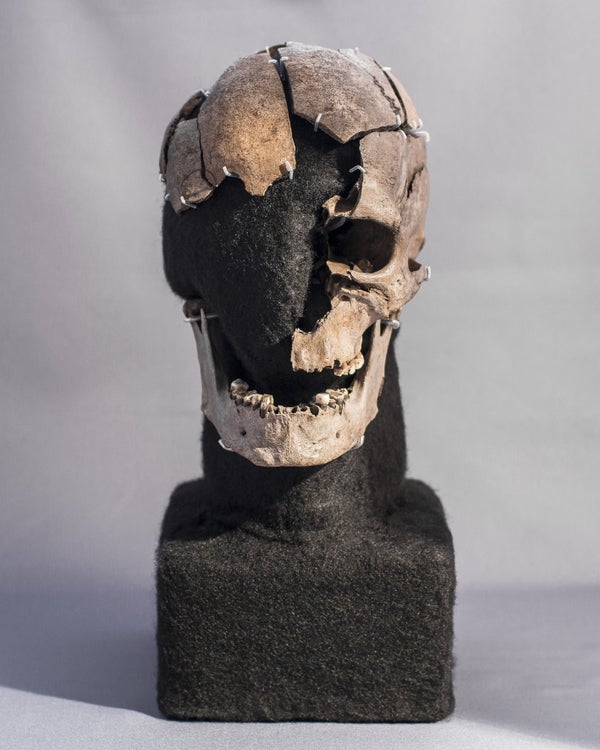
Before he was bludgeoned to death and left in a Danish bog, an ancient individual now known as Vittrup Man was an emblem of past and future ways of living.
He was born more than 5,000 years ago into a community of Mesolithic hunter-gatherers who probably lived in northern Scandinavia as their ancestors had for millennia. But Vittrup Man spent his adult life across the sea in Denmark among farming communities, whose ancestors came from the Middle East.
It’s impossible to know the lives that Vittrup Man touched during his lifetime, but it was his death that caught people’s imagination thousands of years later. His remains — ankle and shin bones, a jawbone and a skull fractured by at least eight heavy blows — were discovered in the early twentieth century in a peat bog near a town called Vittrup in northern Denmark, alongside a wooden club that was probably the murder weapon.
On supporting science journalism
If you're enjoying this article, consider supporting our award-winning journalism by subscribing. By purchasing a subscription you are helping to ensure the future of impactful stories about the discoveries and ideas shaping our world today.
His “unusually violent” death distinguished Vittrup Man from other similarly aged remains found in bogs, says Karl-Göran Sjögren, an archaeologist at the University of Gothenburg, Sweden, who co-led a team that charted Vittrup Man’s life in a study published last week.
But nothing else about Vittrup Man stood out until researchers examined his ancestry for a study that came out earlier this year. Vittrup Man, they learnt, was related to hunter-gatherers from what is now Norway and Sweden, and not to the farming communities with Middle Eastern roots that had arrived in Denmark hundreds of years before his death.
“This is an indication that his origin may be a bit further north,” says Sjögren, possibly near the Arctic Circle where people still lived by fishing, hunting and gathering. Carbon and nitrogen isotope levels in bones and teeth, which can reveal aspects of diet, suggest that Vittrup Man got his calories from the ocean as a child, before transitioning to freshwater fish and wild game as a teenager and a diet including cereals, dairy and meat typical of farming communities starting as a young adult. Incorporated into his teeth, the researchers found protein fragments from seals, whales and fish as well as sheep or goats.
A childhood among northern Scandinavian hunter-fisher-gatherers might have prepared Vittrup Man for a long open-sea voyage to Denmark. What’s not clear is why he left the familiar to live among farmers. Some archaeologists, including some of Sjögren’s co-authors, surmise that Vittrup Man was taken captive and enslaved before being killed — a fate not uncommon in early Neolithic Scandinavia, when numerous social groups coexisted.
Sjögren favours the idea that Vittrup Man lived like a foreign merchant, mediating the exchange of goods between farmers and hunter-gatherers. Flint axes made of high-quality Danish stone, which have been identified along the Norwegian coast, could have been traded for materials from northern Scandinavia such as basalt.
“Maybe once he came of age, his role in society was to establish connections with farmer that lived across the sea,” says Thomas Booth, a bioarchaeologist at the Francis Crick Institute in London. He lived with the farmers for the last decades of his life, but it’s not inconceivable that he voyaged back and forth between homes old and new, adds Sjögren.
What, then, of Vittrup’s Man violent death, probably in his early thirties? Dozens of Neolithic human remains — many of them young males, like Vittrup Man — have been discovered in bogs, and archaeologists think ritual sacrifice explains many of these deaths. Many of these people had bone malformations that would have marked them out among their peers, but not Vittrup Man, says Sjögren.
Genome analysis suggests that Vittrup Man was blue-eyed and his skin may have been darker than typical Neolithic farmers, but his dark hair colour and height wouldn’t have stood out. “Why they chose to sacrifice some people, it’s really hard to say,” says Sjögren.
Vittrup Man’s hunter-gatherer ancestry more or less vanished from all of Scandinavian in the centuries after his death, and it’s not clear if any close relatives survived him. Researchers sequencing ancient human genomes by the hundreds have begun to build genealogies of ancient families, and it’s not inconceivable that a relative could one day be found.
The life — and death — of Vittrup Man goes to the heart of one Europe’s biggest transitions, says Booth, when hunter-gathering communities like his sat on the edge of a new way of life. “It gives you a sense of the worlds that these people are inhabiting.”
This article is reproduced with permission and was first published on February 21, 2024.